


Finding time for a trip with old friends takes some organising when you’re juggling work, childcare and everyone’s diaries. I have friends living all over the place from Scotland to London so we don’t get many opportunities to spend more than a few hours together.
A short hut to hut hike is one of my favourite active girls’ trip ideas. We get several days to walk and talk, catch up over dinner and enjoy the mountains, with very few distractions.
Once I’ve sorted the route and bookings, our main job is to walk to the next hut, where someone else makes dinner!
I’ve been hut hiking for decades, starting with joining my parents on sections of their GR5 walk from Geneva to Nice. I do a lot of hut hiking with my own kids too, but I also love getting away into the mountains with friends. There are usually two to six of us, and I’m the one who organises everything; my friends just have to book the flights or trains I tell them to and turn up!
All six of these routes (I’ve done them all!) involve three days of hiking and two nights in huts. Add a hotel night before and after, and you’ve got a four night trip, which is much easier to fit around everyone’s busy schedules than a full week away.
The hikes span Italy, Austria and France, from less demanding routes to challenging, long distance mountain treks.
I’ve walked five of them on girls’ trips and the Meraner Höhenweg solo, although it would make a great first hut hike with friends as well.
Disclaimer: This post contains affiliate links. As an Amazon Associate I earn from qualifying purchases. Should you click on a link to purchase, it is at no extra cost to you, but I may receive a small commission, which helps to support this blog (THANK YOU)! See my privacy policy for more information. This post was written (and rewritten!) by Bea – always honest and always based on real-life experience.
Why a hut to hut hike makes a great trip for busy mums
I love travelling with my kids, but getting away with friends gives us time for the sort of catch up that we rarely manage at home. When everyone lives miles apart, a few days together without the rest of the family makes a big difference.
Walking gives us hours to chat and catch up, without trying to squeeze everything into a couple of hours before someone needs to get home. You can chat to one friend for a while, then another, and still have dinner together as a group that evening.

There’s also very little to organise once we’re on the trail. I’ve booked our beds and worked out the route beforehand; the huts provide dinner and breakfast, so nobody needs to cook or negotiate where we’re eating each night.
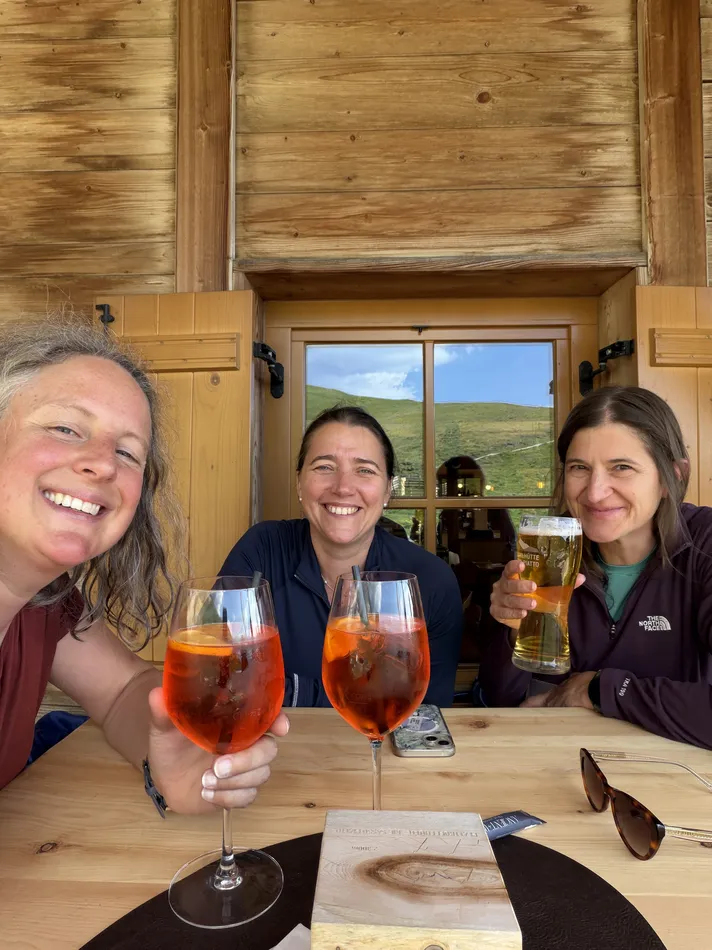
You don’t all have to be equally fit. Choose a route that suits the least active person in the group. If some of us find it easy, that’s fine; we’re there to spend time together. The particularly energetic friends can always add an extra summit while the rest of us have an Aperol at the hut!
You do need to be happy with simple accommodation and sharing a room. I usually try to book a private room for our group, although facilities and availability vary between huts. My beginner’s guide to mountain huts explains the sleeping arrangements, food and practicalities if you haven’t stayed in one before.
For me, four nights away is a manageable amount of time to arrange around family life, while still giving us enough time to properly catch up. And a hotel night after the hike means we can finish with a shower, clean clothes and a final dinner together.
Six active girls’ trip ideas in Europe, from easiest to hardest
I’ve arranged these routes from easiest to hardest based on my own experience. This is inevitably a little subjective; one person’s enjoyable climb is another person’s reason never to speak to the trip organiser again (so far, this hasn’t happened to me though…)!
Distance is only part of the picture. Daily ascent, steep descents, exposed paths and the weight of your backpack all affect how hard a route feels. The weather can change things considerably too.
None of these is an easy countryside walk, but you don’t need to be a mountaineer. Start with a route that feels well within your group’s capabilities, especially if this is your first time hiking together.
| Route | Location | Total distance | Total ascent | Best for |
|---|---|---|---|---|
| Meraner Höhenweg | South Tyrol, Italy | 28.1 km | 1,260 m | A great first hut to hut hike with friends (thermal baths at the end too if you want a bit of luxury!) |
| Tal der Almen | Grossarl, Austria | 33.3 km | 2,160 m | Fit walkers who want excellent huts, food and mountain lakes |
| Around the Bischofsmütze | SalzburgerLand, Austria | 40.1 km | 2,060 m | A fairly challenging hike with classic Austrian scenery |
| Val di Fassa | Dolomites, Italy | 35.4 km | 2,290 m | Confident hikers looking for a proper Dolomites trip – I haven’t got a route guide for this one yet |
| Wilder Kaiser | Tyrol, Austria | 40.8 km | 2,060 m | Strong hikers comfortable with steep mountain paths and long days |
| GR5 from Modane to Briançon | French Alps | 61.4 km | 3,120 m | Experienced groups ready for the toughest route on this list |
I’ve included the practical details for each route below, including what makes it a good trip with friends, how difficult I found it and where you could stay before and after the hike.
1. Meraner Höhenweg, South Tyrol, Italy
Best for: A first hut to hut hike with friends
Distance: 28.1 km
Total ascent: 1,260 m
Hut nights: 2
The Meraner Höhenweg is the shortest and least demanding route on this list, although it still includes proper mountain paths, quite a bit of up and down, suspension bridges and some exposed sections. I walked it solo, but its manageable distances and relatively modest ascent would make it a good first hut to hut hike with friends.

The route starts and finishes close to Meran, where you can book the same accommodation before and after the hike and leave behind anything you don’t need in the huts. You could also add a recovery visit to Therme Meran before travelling home.
Read my complete three-day Meraner Höhenweg itinerary or buy the printable route guide for £12, which includes the daily routes, accommodation details, maps and practical planning information.
2. Tal der Almen, Grossarl, Austria
Best for: Fit walkers who want excellent huts, food and mountain lakes
Distance: 33.3 km
Total ascent: 2,160 m
Hut nights: 2
This three-day hike through Grossarl’s Tal der Almen was a girls’ trip for four of us. It has considerably more climbing than the Meraner Höhenweg, but the days are manageable for a reasonably fit group and the welcoming huts are a large part of the appeal.
The route passes through green meadows and rolling mountain scenery, with a beautiful mountain lake along the way.

The hike is accessible by public transport from Salzburg. Read my complete three day Grossarl Valley hut to hut itinerary for the daily routes, hut details and transport information.
3. Around the Bischofsmütze, Austria
Best for: A fairly challenging hike with classic higher altitude Austrian mountain scenery
Distance: 40.1 km
Total ascent: 2,060 m
Hut nights: 2
This circular route around the distinctive Bischofsmütze mountain has a mixture of green alpine scenery and more rugged, rocky paths. It is longer than the Grossarl hike, but has a similar amount of climbing spread across the three days.

We stayed in Filzmoos before and after the hike, making it easy to leave our spare luggage at the hotel. It is a good option if you want a proper mountain hike that is challenging without being one of the toughest routes on this list.
Read my complete two night Bischofsmütze hut to hut itinerary for the route, hut details and travel information.
4. Val di Fassa, Italy
Best for: Confident hikers who want dramatic Dolomites scenery
Distance: 35.4 km
Total ascent: 2,290 m
Total descent: 1,900 m
Hut nights: 2
This route doesn’t have its own blog post yet, so I’ve included a little more detail here to help you plan it.
This was a three-day girls’ trip through the Dolomites, staying at Rifugio Antermoia and Plattkofelhütte. The route has plenty of climbing and reaches higher, rockier terrain than the first three hikes, with the sort of enormous limestone scenery you hope for from the Dolomites.
We based the route on this official Dolomiti Trek King autumn itinerary, but I adapted the final day to finish at the top of the Col Rodella cable car. We then took the cable car down and caught a bus back to our hotel.
Where we stayed before and after the hike
We stayed at X Alp Hotel in Pera di Fassa on both sides of the hike. It is right next to the Vajolet lift that we needed to reach the start of the route, and the hotel allowed us to leave our spare luggage there while we were in the mountains. This meant we only had to carry what we needed for two nights rather than everything we had brought to Italy.
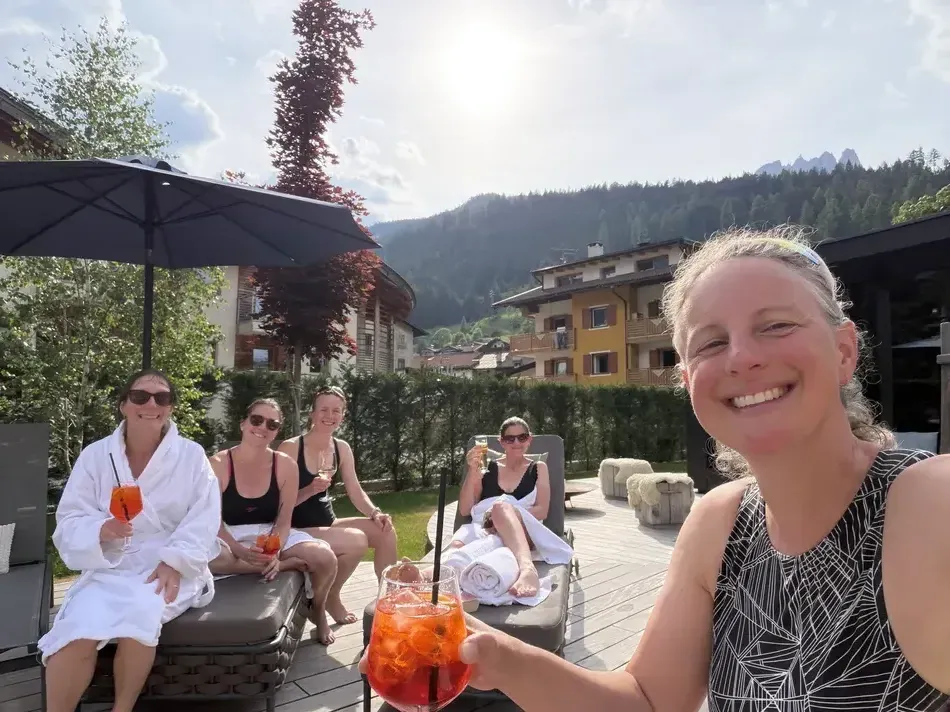
We flew into Bolzano and arranged a taxi to Val di Fassa. Staying at the same hotel again after the hike made the logistics much simpler, particularly when we came down from Col Rodella tired, hungry and ready for a shower – and it was great to be able to use the hotel’s natural swimming pool, sauna and hot tub facilities too!
The three-day route
On the first day, we used the Vajolet I and Vajolet II chair lifts (which start next to the X Alp Hotel), followed by the Pian Pecei Ciampedie chair lift, to gain height before hiking to Rifugio Antermoia, with a very steep out and back detour to the remarkable metal-clad Santnerpasshütte.
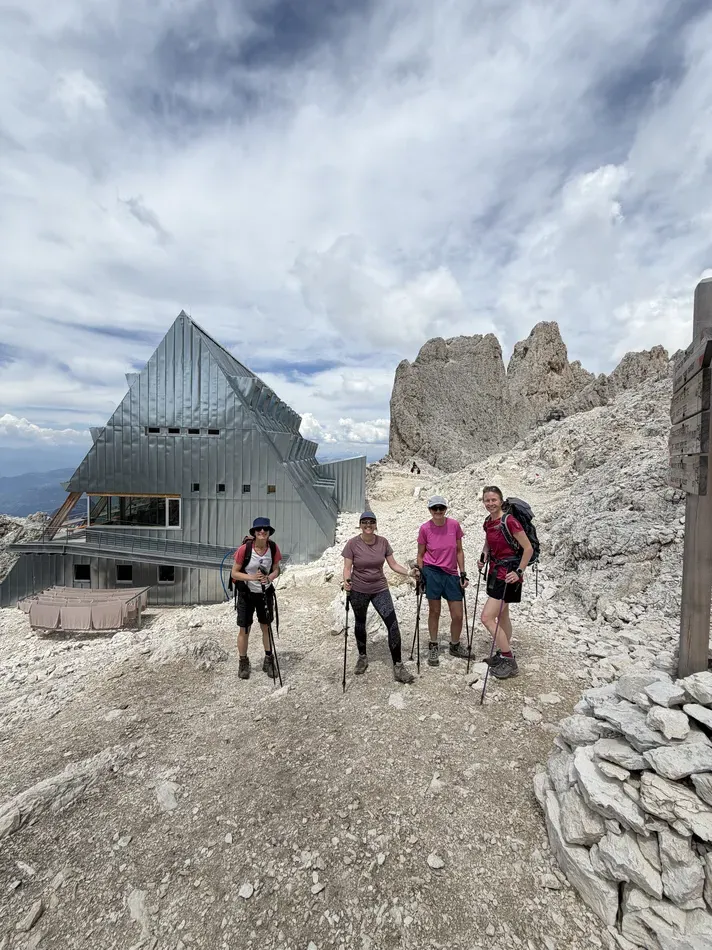
The second day, which was a little easier, took us through the Dolomites to Plattkofelhütte on the Seiseralm.
On the final day, we walked round the back of the Sassopiato and Sassolungo mountains to the top of the Col Rodella cable car, which we used to descend back into the Val di Fassa valley. From there it was a short bus ride back to Pera di Fassa and our hotel.
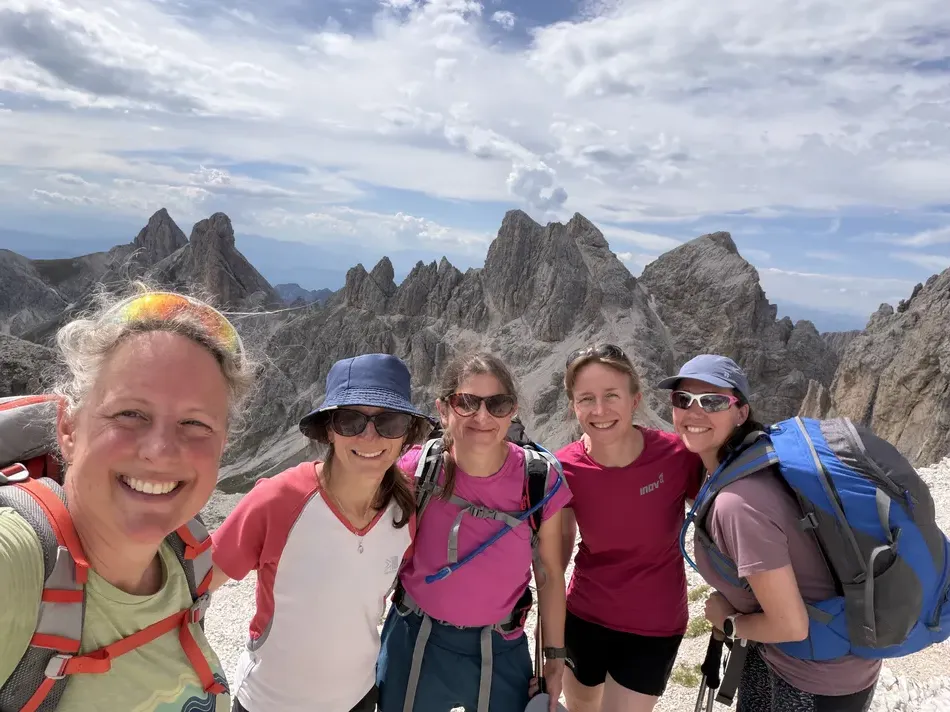
This is a good choice for a group with previous mountain hiking experience. The distances are not enormous, but the amount of ascent, high altitude terrain and rockier paths make it quite a lot more demanding than the routes earlier on this list.
Having said that, the out and back to the Santnerpasshütte on day one is very much optional, and missing that out would make the route less demanding overall.
5. Wilder Kaiser, Austria
Best for: Strong hikers comfortable with steep mountain paths
Distance: 40.8 km
Total ascent: 2,060 m
Hut nights: 2
With its dramatic limestone peaks, the Wilder Kaiser is a step up in difficulty, despite having less total ascent than the Val di Fassa route. The paths are steeper and more demanding, with some technical sections involving ladders and cables. There are also some long days carrying everything you need.
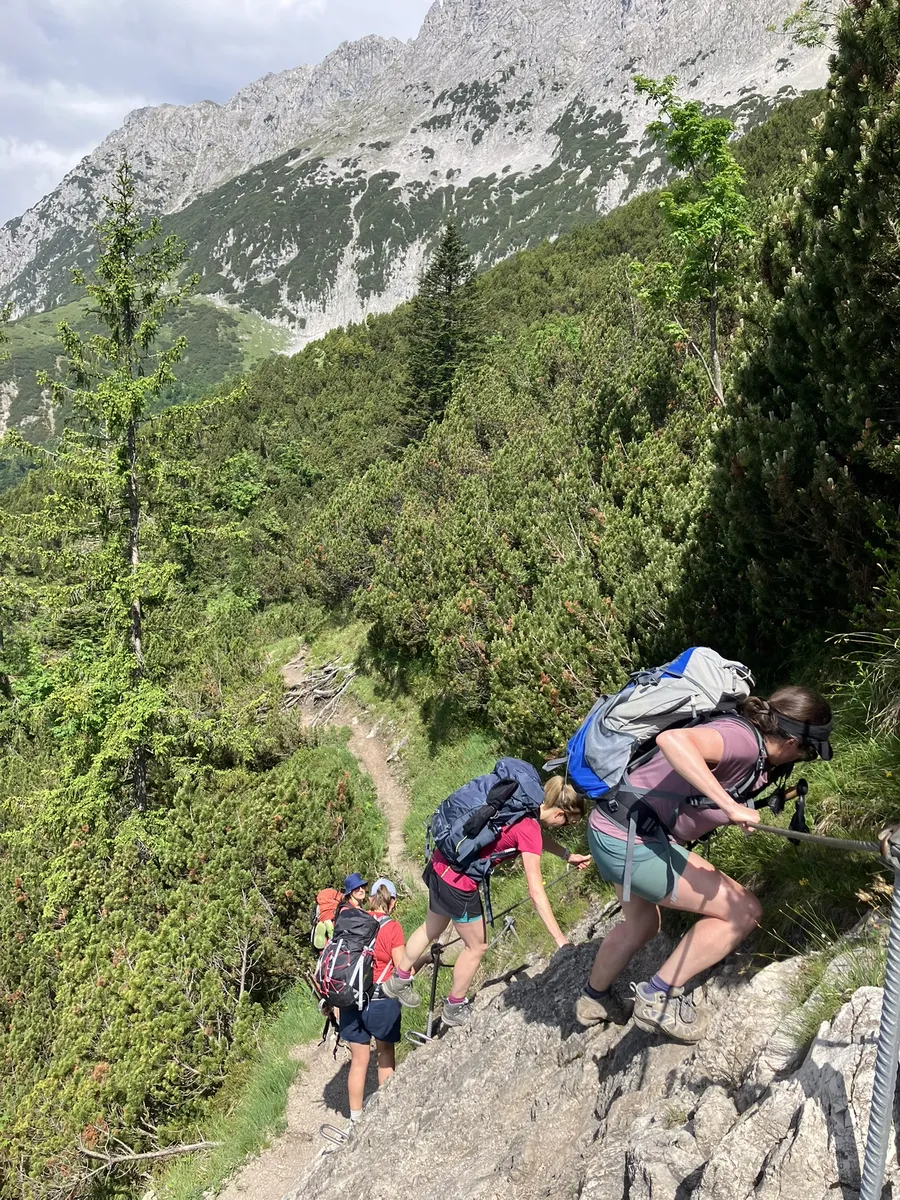
We stayed in Kufstein before and after the hike, which is a great little town with a fantastic fortress, and also meant we could leave our spare luggage at the hotel. This is a good choice for an experienced group looking for a challenging three-day hike rather than a gentle introduction to hut hiking.
Read my complete three-day Wilder Kaiser hut-to-hut itinerary for the route, hut details and transport information.
6. GR5 from Modane to Briançon, France
Best for: Experienced groups ready for the toughest route on this list
Distance: 61.4 km
Total ascent: 3,120 m
Hut nights: 2
This section of the GR5 is both the longest route on the list and the one with the most climbing. It crosses several high mountain passes through the French Alps, with long, demanding days and fewer easy options for cutting the route short.

Unlike the other trips, it starts in Modane and finishes in Briançon, so you need to carry everything with you rather than leaving spare luggage at the same hotel. I would save this one for a group whose fitness and mountain experience you already know well.
Read my complete three-day GR5 itinerary from Modane to Briançon for the route, accommodation and travel details.
How much does a four-night hut hiking trip cost?
These trips can be surprisingly affordable, although the total depends heavily on flight prices, transfers and what is included at the huts. A typical trip involves travelling in term time (so cheap flights!) one hotel night before the hike, two nights in huts and another hotel night afterwards.
These are the approximate per-person costs from four of our trips. They are historical costs rather than current prices, but they give you a realistic starting point.
| Trip | Year | Approximate cost per person | What was not included |
|---|---|---|---|
| Around the Bischofsmütze, Austria | 2024 | Around €285 before flights to Salzburg | Flights, lunches, some dinners and drinks |
| Tal der Almen, Grossarl, Austria | 2025 | £318.85, incl flights to Salzburg | Some meals, drinks and bus fares |
| Wilder Kaiser, Austria | 2025 | £522.15, incl flights to Munich | Some meals and drinks |
| Val di Fassa – Dolomites | 2026 | Around £700, incl flights to Bolzano | Some meals and drinks |
The Grossarl total included flights, public transport and four nights’ accommodation. The Wilder Kaiser trip included flights, trains, taxis and accommodation. Our Val di Fassa trip was the most expensive, largely because the flights to Bolzano cost €353.92 per person and the Dolomites are much more expensive than Austria! Its total also included transfers and an estimated €33 for the lifts.
For the Bischofsmütze trip, the €285 per person was before flights and extra food. This covered two hotel nights, two hut nights and our share of the taxis.
Huts are not necessarily the expensive part. Flights and private transfers made the biggest difference to these totals, while travelling by public transport and booking early kept the Grossarl trip relatively cheap.
Prices change each season, so use these figures for comparison rather than as a budget quote. You will also need spending money for lunches, drinks and any hut meals not included in the room price.
How to plan a hut to hut trip with friends
When you’re planning a group hiking trip, you need to find a route that works for everyone coming!
Plan for the least confident hiker
Be realistic about the group’s fitness, hiking experience and feelings about heights. It’s best to plan around the least fit or least confident person rather than choosing a route that will push the strongest hikers.
If the main purpose is to spend time together and catch up, it doesn’t matter if some people find the route easy. The more energetic members of the group can always add a nearby summit while everyone else orders an Aperol.
Keep the trip manageable
Each of these itineraries involves three days of hiking and two nights in huts. With one hotel night before the hike and another afterwards, the full trip takes four nights.
That has worked well for us because it feels like a proper trip without requiring everyone to use a full week of annual leave or arrange too much childcare.
Choose June or September if you can
June and September are ideal months for this type of trip. You are outside the busiest summer period, there is generally better availability in the huts and flights are often much cheaper than during the UK school holidays. You also have a great chance of good hiking weather, although nothing is guaranteed in the mountains.
Earlier or later in the year becomes more difficult, particularly on the higher routes. Mountain huts and cable cars may be closed, and snow can remain on the paths well into early summer or arrive again in autumn. Lower-altitude routes may have a longer season, but always check the opening dates for every hut and lift before booking your travel.
Book the same hotel before and after
Where possible, book the same hotel on both sides of the hike and ask whether you can leave a bag there (I’ve never heard a “no” to that question). You can travel with everything you need for the wider trip, then carry only your hut hiking kit in the mountains.
This worked particularly well in Kufstein, Filzmoos and Val di Fassa. It is less straightforward on a linear route such as the GR5, where you finish in a different town and need to carry everything with you – we had to really shave down our packing list before leaving home for that trip.
What to expect from the mountain huts
Mountain huts are not hotels, but that does not mean you will necessarily be sleeping in a huge dormitory. Many huts have private rooms for two to six people, which work well for a group of friends. You do need to be comfortable sharing a room with each other!
Facilities vary. Some huts have showers and private rooms, while others have shared bathrooms, limited hot water or showers that cost extra. The accommodation is simple, but usually comfortable, warm and very cosy once everyone has arrived for the evening.
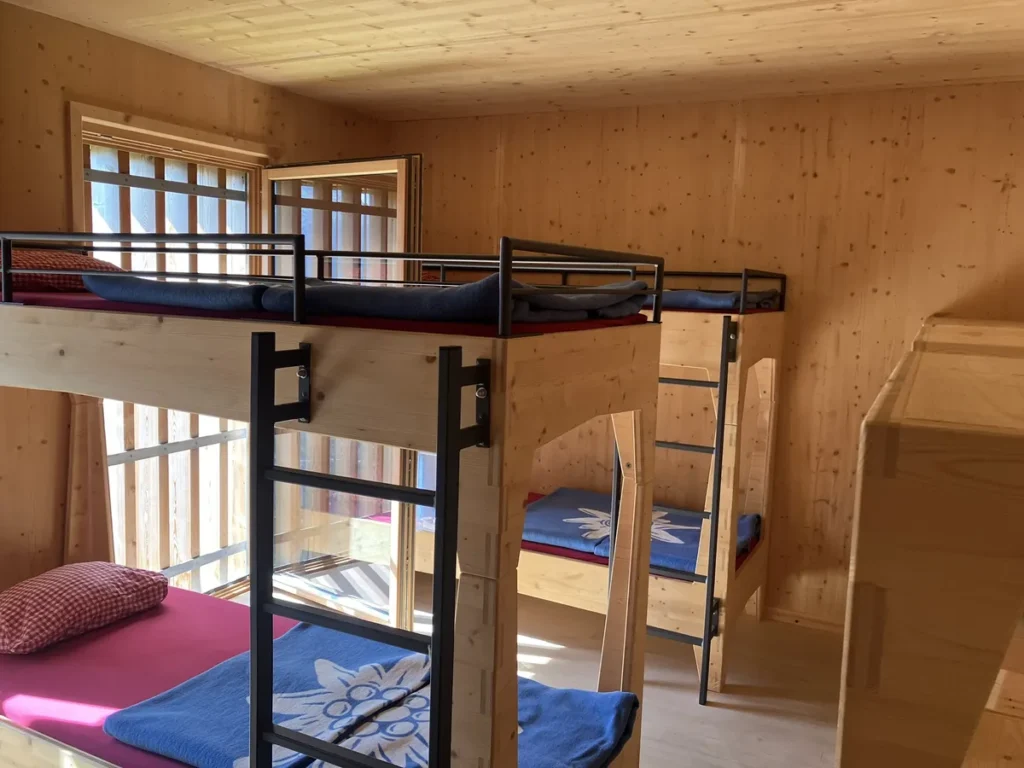
Dinner and breakfast may be included in a half-board rate, or you may order meals separately. I make sure everyone knows how the huts work before the trip and that they know what to pack (often you need hut specific things like sleeping bag liners and hut slippers), how much cash to carry and what they should leave behind!
For more detail, read my A beginner’s guide to mountain huts: Essential tips for first-timers. It’s got practical information about rooms, meals, showers and hut etiquette. I also recommend you have a read of What to Expect in Austrian Mountain Huts – especially if you decide to go to Austria!
What size backpack do you need for a two night hut hike?
For a three day hike with two nights in huts, around 30 to 40 litres should be enough. You do not need camping equipment, a sleeping bag or multiple changes of clothes, so there is no reason to fill a huge trekking pack, but you should make space for one change of clothes, your sleeping bag liner (mandatory at most huts), hut slippers (if they’re not provided), and some emergency equipment between you, like a good first aid kit and an emergency shelter.
Fit matters more than the exact capacity. Look for adjustable shoulder straps, a supportive hip belt and pockets you can reach without unpacking everything. A rain cover is useful, but I also put clothes and electronics inside waterproof bags because rain covers are not entirely trustworthy in mountain weather.
Here are three backpacks worth considering:
- Best budget option: The Decathlon MH100 35L backpack is a good value size for a short hut to hut hike. It’s pretty basic, and not women’s specific, but it gets pretty good reviews!
- Premium option: The Gregory Jade 38 gets excellent reviews and many claim it is likely to fit within airline cabin-baggage limits if not packed too full. Always check the dimensions against your airline’s allowance before flying.
- The backpack I use: I use the Decathlon MT900 Women’s 45+10L lightweight trekking backpack (pictured below) and really like it. It is larger than you need for two hut nights, but it is really lightweight, adjustable, loads of outside pockets, breathable back and very good value for what you get. You do not have to fill it, and a partly empty backpack can be easier to pack and more comfortable than one with everything wedged tightly inside.

Just be ruthless about what you take, because your shoulders, back and legs will notice every unnecessary item by the third day!
What else should you pack for a hut to hut hike?
Always pack for changing mountain weather. For a two night hut hike, I would take:
- Worn-in hiking boots or trail shoes
- A waterproof jacket (and possibly waterproof trousers)
- A couple of warm layers (including a packable down jacket), even in summer
- Hiking clothes, spare socks and minimal evening clothes for the huts
- A lightweight sleeping-bag liner, which is required in many huts
- Sun cream, sunglasses and a sun hat
- A small first-aid kit and blister plasters
- A refillable water bottle and snacks
- A head torch
- A phone, charging cable and power bank
- Cash, photo ID and travel-insurance details
- Basic toiletries and a small quick-drying towel
- An offline route, plus a paper map as backup
My complete packing list for hut hiking adventures in the Alps includes more detail, but resist taking every possible “just in case” item.
I plan and download our routes using Komoot, but I also carry the appropriate walking map or guidebook, just in case of a phone malfunction!
For group trips, it’s a good idea to agree who is carrying shared items like the first aid kit, any emergency shelter, and even things like toothpaste and sun screen if you’re really looking to shave down weight!
Booking a hut hike for a group
For our trips, I choose the route and book the huts, hotels and transfers. My friends then book the flights or trains I send them. Having one person coordinate the itinerary works well, and it’s not very difficult, as most huts and taxi transfers can be booked online these days, often with a small deposit, or even no deposit at all.
Mountain huts can be small, and private rooms for four to six people often book up first. Agree your dates and reserve the huts before booking non-refundable travel, particularly if you want to hike over a weekend or during the main summer season. (Chose June or September for good weather but without the crowds)!

Check what each booking includes. Some huts charge half board, while others list the room, breakfast and dinner separately. You may also need to pay a deposit by bank transfer and it’s likely you’ll settle the balance in cash when you arrive.
I keep a simple record of every payment and tell everyone exactly what they owe. While we’re out there, Splitwise is great for keeping track of group payments.
When confirming the rooms, make sure you tell them about dietary requirements and make sure everyone understands the cancellation terms.
Ready to plan your own active girls’ trip?
A four night hut hiking trip is long enough to spend proper time with old friends, but short enough to fit around work, childcare and everyone’s already complicated diaries.
Choose a route that suits the whole group, agree a date (this is the hardest bit!) and book the huts while you’ve got the enthusiasm in the group chat! It’s so so worth it.
If you are looking for active girls’ trip ideas for a first hut hike, I would start with the Meraner Höhenweg or Tal der Almen in Grossarl. More experienced groups can work their way towards the Wilder Kaiser, Dolomites or GR5.
Send this article to the friends you would take, find four nights you can all manage and get something in the diary.
Start planning your own hut to hut hike
Planning your first hut hike
- A beginner’s guide to mountain huts: Essential tips for first-timers
- Complete packing list for hut-hiking adventures in the Alps
- When to book mountain huts so you’re not left without a bed
- What to expect in Austrian mountain huts
- Komoot for beginners: Why I love it for planning our adventures
