


Hut to hut hiking in Austria is hands-down one of my favourite ways to spend my time. I’ve dragged my whole family (from my kids to my parents in their mid-70s), and many, many foolhardy friends (even ones that came all the way from Australia!) all over the mountains in Austria.
They’ve all been as delighted as I am by the joys of spending all day outdoors in the mountains, experiencing awe inspiring views, carpets of wild flowers, exhausting climbs and chilly lake swims, followed by a cold beer on a sunny terrace*.
*(okay, maybe an Almdudler for the kids – if you don’t know what that is – please try it once this post persuades you to head to Austria)!
I can’t neglect to mention the huge slices of home made apple strudel, deliciously pine-scented bedrooms with gingham bedcovers and curtains that make you feel like you’re a character in Heidi, and simply the time in the evenings to spend with each other – disconnected from phones and wifi – playing games, or simply catching up.
It’s by far the easiest way to fall in love with the Alps, even if you’re new to multi-day hiking, and I’m here to help you plan a route that’s genuinely rewarding. I’ve written up in detail a number of routes which I’ve done over the last few years – and unlike most guides, all these routes skip the tourist traps.
Some of these routes I’ve done with kids, and some without. It’s important that you know that my “with kids” itineraries are not dull; they’re exactly what many first-time adults want too: manageable days, big views, proper food and a comfy bed at the day’s end.
Why is hut hiking in Austria so great? The short answer: superb hut network, spotless waymarking, a public transport infrastructure that actually gets you to trailheads, and routes that range from cow bells and meadows to above-the-tree-line scree slope passes. And unlike the Dolomites, you’re not queuing for viewpoints; you’ll meet plenty of fellow hikers, but it’s never a circus.
Austria is just absolutely beautiful, with a huge variety of landscapes, from awe inspiring to bucolic, but never overrun. You can bagsy a private room if you book early, toast the sunset with something cold on the terrace, and you won’t need to hire a car. Not bad for a first dip into the Alps.
Here’s what you’ll find below 👇
- 📅 When to go and how to time it around lifts, buses and the afternoon storm window
- 🏡 How mountain huts work (what “hut” really means, and how to get that private room)
- 🚌 Where to base yourself and how to reach trailheads car-free
- 🗺️ Six tried-and-tested 3 day, 2 night routes to choose from (family-friendly and adult-friendly)
- 🎒 Packing, costs, booking tips & hut etiquette to help you feel prepared, not panicked
Disclaimer: This post contains affiliate links. As an Amazon Associate I earn from qualifying purchases. Should you click on a link to purchase, it is at no extra cost to you, but I may receive a small commission, which helps to support this blog (THANK YOU)! See my privacy policy for more information. This post was written (and rewritten!) by Bea – always honest and always based on real-life experience.
What is hut to hut hiking (and why Austria is ideal for first-timers)
Hut to hut hiking is exactly what it says on the tin: you walk from one mountain hut to the next over a few days, carrying just what you need, sleeping in a simple room, and eating hearty food cooked for you.
In Austria, the system is exceptionally well organised. The Austrian Alpine Club (ÖAV) and private “alm” farms run a dense network of huts linked by clearly waymarked paths, with public transport and lift access that make starts and exits straightforward.
What does “alm” mean?
In Austria and Bavaria, an Alm is a summer mountain pasture – often with a working farmhouse or dairy that serves simple food and has a few guest rooms. Some alms operate much like small inns in hiking season, while Alpine Club huts are purpose-built for mountaineers. You’ll meet both on Austrian hut to hut routes. For more information read: What to expect in Austrian mountain huts.

Why hut to hut hiking in Austria is especially good for beginners (and mixed-ability groups):
A quick word for the grown-ups eyeing my “with kids” itineraries: they’re ideal for first-time adults too. Just because I’ve done them with kids doesn’t mean they’re “easy” or boring – they’re scenic, satisfying and confidence building, letting you dip a toe in before committing to longer traverses.
- Manageable stages. My Austrian itineraries are 2–3 days with options to shorten, extend or bail out.
- No crowds. Austria’s trails are well used, but quiet compared to the busiest Dolomites circuits. You won’t be queuing for viewpoint photos!
- Clear signage. Yellow waymarkers and frequent junction signs keep you pointed in the right direction.
- Choice of hut styles. Big Alpen Verein huts with drying rooms and set dinner times, or smaller alms with a more homely feel.
- Car-free logistics. Trains, local buses and dedicated Wanderbuses (see below!) get you to trailheads without faff.
- Terrain variety. From gentle meadow paths to rockier passes if you fancy a bit more spice.
What is a “Wanderbus”?
Wanderbus literally means “hiking bus”; seasonal shuttle services that run to and from trailheads. They usually operate in summer (often late June – early September), link villages with cable cars and key trailheads and even road-accessible mountain huts, and are timed around popular hiking routes.Expect normal local-bus fares or a small surcharge; some routes are free with a local mobility card (often provided by your accomodation).
They are often cash-only and a few require booking the day before.
If a Wanderbus isn’t running, check the local tourist-info site – they often list taxis that do fixed-price trailhead runs.
⚠️ Mountain huts are much more than huts! What a “hut” really entails:
- Rooms: Expect anything from shared dorms to small private rooms. “Private” usually means your group has the room, but is not en-suite. If you want privacy, book early.
- Bathrooms & showers: Shared facilities are the norm. Showers often run on a paid token system; bring a small towel.
- Food & drink: Dinner is typically half-board, and dinner could be a set meal, a choice of 3 options, or a full à la carte menu. Food tends to be excellent (and child friendly), portions are generous; vegetarians are fine if you mention it in advance. Breakfast is usually a handsome and filling buffet. Terrace drinks at sunset are practically a ritual (Aperol or Almdudler — your call).
- Money: Most huts are cash-only.
- Power: Sockets are limited; pack a power bank.
- Hut etiquette: Boots off at the door, hut slippers/crocs inside; quiet hours are to be observed; bring a light sleeping-bag liner for dorms.
- If you want a deeper primer on what huts are like in Austria, this post is useful: What to expect in Austrian mountain huts.
When to go hut to hut hiking in Austria
Late June to September is your window for hut to hut hiking in Austria. Earlier means snow on higher passes (and closed huts and cable cars if they make up part of your itinerary). Later brings cooler weather, but less daylight and the odd early snowfall.
Month by month
- June: Early season charm, wildflowers and longer days. High passes can still hold snow; expect snow patches and meltwater. Many huts open mid to late June; always check.
- July: Prime time. Most huts, cable cars and hiking buses are running, alpine meadows are at their best. Weekends are busier; book private rooms well ahead.
- August: Warm, lively and and can be stormy. (We always hike in August though, don’t let this put you off)! Afternoon thunderstorms are more common. If they’re forecast, start early, and aim to finish by mid-afternoon.
- September: Often the sweet spot. Cooler, clearer, fewer crowds, and turning larches at higher elevations. Lifts and huts begin to wind down mid month; check closing dates and last-lift times.

Key timing tips
- Check hut opening dates (and any required lifts / buses) before you lock in your route.
- Plan around lifts and buses. Check the time tables. Last lifts are non-negotiable; don’t leave your finish to luck.
- Book early for private rooms – especially during weekends and school holidays.
- Start early, finish early. A late lunch on the terrace is more fun than sprinting for shelter in a hailstorm!
- Midweek tends to be less busy than weekends if you want quieter dorms and easier bookings.
- Build in some slack. Bad weather happens; keep stages short enough that you can wait out a storm or re-route.
- Carry cash. Most huts don’t take cards.
- Watch the forecast; and ask hut staff. They’re your best local read on storm timing, current route conditions and sensible alternatives.
For more on calendars and lead times, see When to book mountain huts (so you actually get a bed).
How to book mountain huts in Austria (for smooth hut to hut hiking)
Booking huts in Austria is often pleasantly old-school; but a growing number (especially Austrian Alpine Club/ÖAV huts) now offer online booking systems that make things very simple. If there’s an online reservation system, use it; if not, email or a message on the contact form works perfectly.
When to book
- Private rooms: 4 to 6 months ahead (earlier for peak weekends and school holidays).
- Dorm beds: 2 to 4 months ahead can be fine, but don’t bank on last-minute in July and August.
- Lift- or bus-dependent routes: only lock dates after checking first and last lifts and seasonal hiking bus timetables. (Or organise a taxi if you’re outside these dates).
Where and how to book
- Check the hut’s website first:
- If there’s an online booking tool, reserve there and keep the confirmation email.
- If not, use the online contact form or listed email address
- If you’re booking short notice once the season has already started, you’ll usually need to phone, as hut staff don’t have time (or internet access) for checking emails once they’re up at the hut full time, and a phone call will get you an immediate response.
- For small private alms, expect email (or in rare cases a phone call!); for larger AV huts, online systems are increasingly common.

Here’s a handy email template for you to copy and paste:
Subject: Reservierungsanfrage – [Hut Name], [Dates] (Reservation request – [Hut Name], [Dates])
Hallo [Hüttenteam], (Hello hut team)
Wir möchten für [number of people] Personen am [dates of your stay] reservieren. (We’d like to book for [number] people on [date(s)].
Gruppe: [number of adults] Erwachsene + [number of kids] Kinder + ages if relevant. (Group: adults + kids + ages if relevant).
Zimmerwunsch: Privatzimmer wenn möglich) / Lager ok. (Room preference: [private room if possible / dorm ok]).
Verpflegung: Halbpension bevorzugt / Vegetarisch x Personen) / Allergien. (Meals: half-board preferred / vegetarian x people / any allergies).
Anreise: zu Fuß ab [Route / or previous hut]; voraussichtliche Ankunftszeit ca. [Time of arrival]. (Arrival: on foot from [route/hut]; ETA approx [time]).
Mitgliedschaft: Alpenverein / keine. (Membership: [Alpine Club / none]).
Bitte teilen Sie uns Preis, Anzahlung bzw. Stornierungsbedingungen und Zahlungsmethode (Bar oder Karte) mit. (Please let us know price, deposit or cancellation terms, and payment method (cash or card)).
Vielen Dank und beste Grüße, (Thank you and best wishes)
[Your name] | [mobile number]
What to expect in the confirmation
- A simple “yes” with price per person, meal plan, and sometimes a deposit request (many huts still don’t take one).
- Sheet-liner requirements (standard in dorms; sometimes in privates).
- Often they will give you a time they’d like you to arrive by, and a phone number to call if that’s not going to be possible on the day
- Payment is often cash at the hut; card terminals are rare at altitude. They’ll probably tell you if it’s cash only – “bar” is the word for cash.
Private room vs dorm (and what “private” means)
- “Private” = your group has the room; bathrooms are (usually) still shared.
- Showers are often token-operated with limited evening hours.
- For first trips or with kids, a small private room is worth booking early for a more comfortable stay (and a lot less snoring!).
One-week reconfirm (don’t forget this)
Especially if you didn’t pay a deposit, send a brief reconfirmation email one week before arrival:
Hallo,
Wir freuen uns auf unseren Aufenthalt am [date], voraussichtliche Ankunftszeit [time].
Mit freundlichen Grüßen, Bea
(We’re looking forward to our stay on [date], ETA [time]. Best wishes, Bea)
This helps the hut plan dinner, room allocations, and prevents crossed wires.
Quick checklist before you hit “book”
Nice-to-know
Alpenverein membership is worth considering: it provides substantial hut discounts (only in the Alpen Verein huts, not the private ones), and mountain-rescue cover, so keep the card/number handy.
A few words of German help, but clear English is fine; short and to the point wins.
And if your plans change, tell the hut. Not arriving when you’ve said you expect to can trigger a call to mountain rescue; you don’t want to be that person!
More detail here if you’d like it: A beginner’s guide to mountain huts.
Where to base yourself for hut to hut hiking in Austria
The good news: Austria is excellent for car-free hiking. Trains get you very close, local buses and “Wanderbuses” – special hiking buses for tourists – finish the job, and in some cases ski lifts pop you straight onto the high paths. If a seasonal bus isn’t running, most tourist-info pages list local taxis that do fixed-price trailhead journeys; worth a look when you’re plotting timings.
Easy bases that pair well with my routes
Salzburg, Filzmoos, Grossarl & Wagrain
Wagrain (Wagrain with kids: what to do, where to stay and more), Grossarl or Filzmoos are all small villages within about 70 km of Salzburg city, which both make excellent bases for hut hiking. Wagrain, Grossarl and St Johann im Pongau are ideal for hiking the longer Grossarltal route or the “taster” overnighter (especially suitable for small kids). Filzmoos is perfect for the Bischofsmütze and family-friendly hut to hut near Salzburg in the same region.
Salzburg is the obvious fly-in / train-in gateway with frequent trains into the mountains which link with buses deeper into the valleys. From here, it’s a train or bus deeper into the mountains to begin your hike.
Kufstein (for the Wilder Kaiser / Adlerweg)
Kuftein makes a cracking summer base with fast rail links and plenty of family-friendly stays; it’s ideal for my three-day Adlerweg mini-traverse in the Wilder Kaiser. Start with Kufstein with kids: Castles, hikes & summer fun if you want an easy, central base.

Lienz (for the Lienz Dolomites)
Laid-back, sunny and well connected by train; it’s perfect for our Lienz Dolomites itinerary. If you’re adding a rest day, try my 16 best things to do with kids in Lienz; pools, summer toboggans, easy peaks, the lot.
Millstättersee
Towns around this gorgeous lake in the south of Austria make a great base for hiking the Millstätter Höhensteig, with great swimming and water sports down by the lake.
Travel to the trailheads is served by the “Nockmobil” which is an excellent mix between a bus and a taxi, offering great value taxi rides between 650 different stops in the local region.
Getting to the start line (and home again)
- Take the train to the nearest hub; switch to regional buses for the final stretch. Austrian buses are great, and the timetables are usually easy to find online. Check if you are eligible for free public transport – in the Salzburgerland in the summer, you get entirely free public transport within the county with just one nights’ stay!
- In places like Grossarl and Filzmoos, there are various shuttles which run hikers to trailheads or mountain huts; from Filzmoos there’s even a mini mountain hut on a tractor “Almi” to take you to one of the mountain huts!
- If a lift is in your itinerary, check lift operation dates and first / last lift times before you book huts; plan your days so you’re not sprinting for the final gondola.
- One-way hikes are easy here because the bus and train infrastructure is so good – so you won’t have to double back somewhere to retrieve a hire car!
Seven tried and tested 2–3 day hut hiking in Austria routes
Here are seven routes I’ve walked myself; all of them really fun and at times exciting routes with a huge variety of huts — but all still doable in a long weekend, without needing a car.
Pick your flavour: mountain meadows and cowbells, or a little scree and some high pass drama. Each one links to a fuller guide so you can start planning straight away!
Compare at a glance
| Route | Days / Nights | Terrain | Family-friendly? | Start/finish and transport | Read more |
| A first hut hike with kids: An overnighter from Grossarl | 2 / 1 | Woodland, alpine pastures, wide views | ✅ Yes, particularly younger kids | Salzburg → Grossarl → Local bus | Full guide |
| Beginner hut to hut (Carinthia: Millstätter Höhensteig) | 3 / 2 | Meadows, lake views, easy summits | ✅ Yes | Klagenfurt → Seeboden am Millstätter See → local bus, Nockmobil | Full guide |
| Family-friendly near Salzburg (Filzmoos) | 3 / 2 | Big mountains, lift assist, rolling plateau | ✅ Yes | Salzburg → Filzmoos → Hikers’ shuttle and taxi | Full guide |
| Lienz Dolomites with kids | 3 / 2 | Limestone peaks, high pass | ✅ Yes (confident kids) | Train to Lienz → hikers bus or taxi | Full guide |
| Around the Bischofsmütze (Salzburgerland) | 3 / 2 | Steeper passes, some scree | ◻️ Adults / sturdy teens | Salzburg → Filzmoos | Full guide |
| Großarltal: Valley of the Mountain Huts | 3 / 2 | Lakes, meadows, longer days | ◻️ Adults / sturdy teens | Salzburg → St. Johann im Pg. → local bus | Full guide |
| Adlerweg taster, Wilder Kaiser (Tyrol) | 3 / 2 | Big limestone walls, long days, some fun trail features like ladders (no equipment necessary) | ◻️ Adults / sturdy teens | Munich or Innsbruck → Kufstein → train, bus or taxi | Full guide |
Grossarl Family Hut Hike — 2 days, 1 night
If you want to try hut hiking with younger children, start here. This short circuit in the Ellmautal is just under 10 km in total, split over two days with one night at the very child-friendly Loosbühelalm.
There’s a decent climb on Day 1, but the distances are short and you pass four huts along the route, with playgrounds, animals and plenty of opportunities for food and cake. Day 2 is mostly downhill. You can reach the start by bus from Grossarl, so you don’t need a car either.
It’s the route I wish I’d found when my own kids were younger: one night, short walking days and a really manageable introduction to sleeping in the mountains.
Read the full guide: A first hut hike with kids: A 2-day, 1-night route from Grossarl
Beginner hut to hut (Millstätter Lake, Carinthia) — 3 days
Ready for a little more? The Millstätter Höhensteig is the next step up from the Grossarl route, with three walking days, two nights in different huts, longer distances and more climbing overall. It’s still very beginner- and family-friendly, with views for miles, clear waymarking and exceptionally child-friendly huts with sandpits, ride-on toys and animals to pet.
Read the full guide: Beginner hut to hut hike in Austria: a family‑friendly route in Carinthia.
Family-friendly near Salzburg (Filzmoos) — 3 days
Take the hikers’ bus up to the start point, and end with the option to descend to the lake at the finish by cable car if you’ve had enough! This is another fantastic first timer route. My favourite hut here is the charming tiny Stuhlalm for views, super friendly hosts and wonderful food. Or you can choose a more strenuous hike in the same area; see “Around the Bischofsmütze” below.
Read the full guide: Family‑friendly hut to hut hiking near Salzburg.
Around the Bischofsmütze (Salzburgerland) — 3 days (adults/strong teens)
This one is also from Filzmoos but you hike straight out of the village, so no help from hikers buses or lifts at the start and end! The itinerary is compact but punchy: some scree, steeper passes, and fantastic views of the Bischofsmütze, a rocky peak at the heart of the hike. We’ve hit early-season snowfields here; come prepared!
Read the full guide: 2 night hut to hut hike in Austria: around the Bischofsmütze.
Lienz Dolomites with kids — 3 days
Sharper limestone scenery – as it’s right on the border of Italy and the Italian Dolomites, but the hike is on sensible, well-signed paths (even if the pass on the second day doesn’t look like that from afar – I can promise you it’s a perfectly decent path when you get up close!). The hut and lake at the Karlsbaderhütte is a show-stopper.
Read the full guide: Austria hut hikes with kids: Lienz Dolomites.

Großarltal: Valley of the Mountain Huts — 3 days (adult-friendly; sturdy teens ok)
This is classic Salzburgerland – meadows, ridges, a swim-worthy lake – and there are options to shorten if needed. We loved the Tappenkarseehütte for its isolated position just above the lake, and the super tiny and friendly Ellmaualm for a warm welcome and the fact that it was a real working smallholding – dinner was a little late because the lovely hostess needed to round up her cows for milking!
Read the full guide: 3 day Großarl valley hut to hut hike accessible from Salzburg.
Adlerweg taster, Wilder Kaiser (Tyrol) — 3 days (adult-friendly; fairly strenuous)
A section of the Eagle Walk (Adlerweg) under the Wilder Kaiser’s famous limestone towers. Think balcony paths, some ladders and metal bridges (you don’t need any equipment, just a decent head for heights), and a recently refurbished AV hut in the Gruttenhütte, followed by a Heidi-esqe wooden farmhouse in the Kaindlhütte, plus the most amazing swim in a turquoise lake en route.
Read the full guide: Wilder Kaiser Hut to Hut Hike from Kufstein, Austria: A Challenging 3 Day Route
If you want help choosing, send me an email with your group’s fitness and appetite for challenge (!) and I’ll nudge you to the best match.
What to pack (and what to leave at home)
Packing for hut to hut hiking in Austria is simple – keep it light. You don’t need expedition kit – just a few layers, a couple of hut-specific bits, and don’t get bogged down with any “just-in-case” stuff! Start with my full list: Complete packing list for hut hiking.
Essentials (don’t skip)
- Waterproof jacket + trousers — weather can be changeable
- Mid-layers — a light fleece or merino wool sweater for cool mornings/evenings.
- Warm outer layer like a lightweight packable down jacket – it chills off quickly up at altitude once the sun goes down
- Base layers + socks — quick-drying; one to wear, one to air.
- Sturdy footwear — grippy soles and ankle support if you need it; break them in before you go.
- Hut shoes — these are often provided by the hut, but feel free to pack your own crocs or hiking sandals.Flip-flops are super light, but if it’s chilly they’re hard to wear with socks!
- Sleeping-bag liner — required in dorms; often required in private rooms too.
- Head torch — for midnight bathroom dashes.
- Power bank — sockets are scarce and often in use.
- Water bottles or soft flasks (1–2 L) — refill at huts and water fountains (check the water is potable first, it isn’t always! But you can buy bottled water if not)
- First-aid + blister kit
- Map + Komoot offline — download your stages and carry a paper map as backup.
Sun gear — cap, sunglasses, high-SPF. - Microfibre towel for showers (make it small!)
- Tiny wash kit — toothbrush, mini paste, a small bar of soap.

Nice to have (small wins)
- Earplugs + eye mask — dorms are friendly… and occasionally snory.
- Lightweight dry bag — keeps things inside your bag organised and dry, and can double as a pillow with a fleece stuffed in.
- Cards / travel game, kindle or audiobook for hut time.
For kids
- Keep packs under ~10 – 15% of body weight; prioritise warm/dry over spare outfits.
- Add a snack stash of their choice (morale matters).
- If you’re kitting out younger hikers, this roundup is exactly what my kids use: The best kids’ hiking gear (tested on the trail) and Best hiking backpacks for kids.
What to leave at home
- Multiple spare outfits; one hiking set + one dry hut set is plenty.
- Heavy toiletries and full-size towels.
- Bulky camera gear unless it’s your thing; a phone does fine on a first trip.
- Camp cooking kit — you’ll eat in huts (and the food is delicious).
Pack it right
- Line packs with a bin liner or dry bag if the forecast looks wet
- Pack the heaviest items close to your back, mid-pack.
- Aim for 10–12 kg for adults on these 2–3 day routes; kids much less.
How much does hut to hut hiking in Austria cost?
If you’re wondering what the damage is, I can tell you from experience that it’s MUCH kinder on the wallet than the famous corners of the Dolomites like the Seiser Alm and the Tre Cime. You’ll also get less crowded and less noisy huts but still get the big views, hot dinners and a comfy bed, just without the “premium for the postcode” price tag.

The small, private alms can be especially good value; expect a warmer, homelier feel and simpler menus (more like a couple of hearty dishes and a meat and cheese board or two) along with a basic breakfast.
And if you’re an Austrian Alpine Club (ÖAV) member, you’ll get about €10 per person off your overnight rate — membership pays for itself fast.
- Half board (dinner + breakfast): about €50–€80 per adult in a private room, €40–€70 for kids, depending on hut and room type.
- Private rooms: a small premium over dorms; bathrooms are usually shared either way.
- Showers: often €2–€3 for a token/timed shower.
- Packed lunch (some huts will offer this, smaller ones might not, ask in advance if you need one): typically €10–€15 (or plan for lunch at an en route hut).
- Lunches at huts: €15 – 25 per person depending on appetite and extras like espresso, pudding or alcoholic drinks.
- Membership discounts: many huts offer Alpine Club (ÖAV) discounts — ask when booking.
- Money tip: carry cash. A small minority of huts take cards now, but most don’t. Assume you need cash unless you’re told otherwise.
FAQs about hut to hut hiking in Austria
Do I need a guide for hut to hut hiking in Austria?
Not on the routes I’ve done or in general if you’re not looking at Via Ferrata routes (unless of course you have climbing or Via Ferrata experience!). Trails are well waymarked and popular beginner routes are straightforward in good weather.
When is the best time to go hut to hut hiking?
Late June to September. Early season can mean snow on passes; late afternoons in August often bring storms. Early season snow can finish the season as early as mid-September. Always check hut opening dates and last lift times.
How fit do we need to be?
For the 2–3 day itineraries here: expect 10–15 km per day with 500–1,100 m ascent.Choose the “family-friendly” ones if you’re unsure about your fitness or if you’re hiking with kids. If you’re an experienced hiker in the UK and with other people in good shape, go for the “adult-suited” routes.
Are your “with kids” routes OK for first-time adults?
Absolutely. Each day is a bit shorter, so bring some entertainment for the afternoons / evenings, but they’re super scenic and still properly exciting. If you still have loads of energy when you arrive at the hut, you can usually find a side hike up to the nearest peak if you’re keen! These routes are ideal for dipping a toe into hut to hut hiking in Austria without committing to a monster traverse.
How early should I book huts?
Private rooms: 4 – 6 months ahead (earlier for weekends / school holidays). Dorm beds: 2 – 4 months is often fine. The earlier you book, the better, as you never know when a large group might book out just the night you need! It’s always good to reconfirm by email a week before, especially if you haven’t paid a deposit.
Do huts take cards?
Most don’t. Carry cash for beds, meals, showers and snacks. Card terminals can be flaky even where they exist.
What about water on the trail?
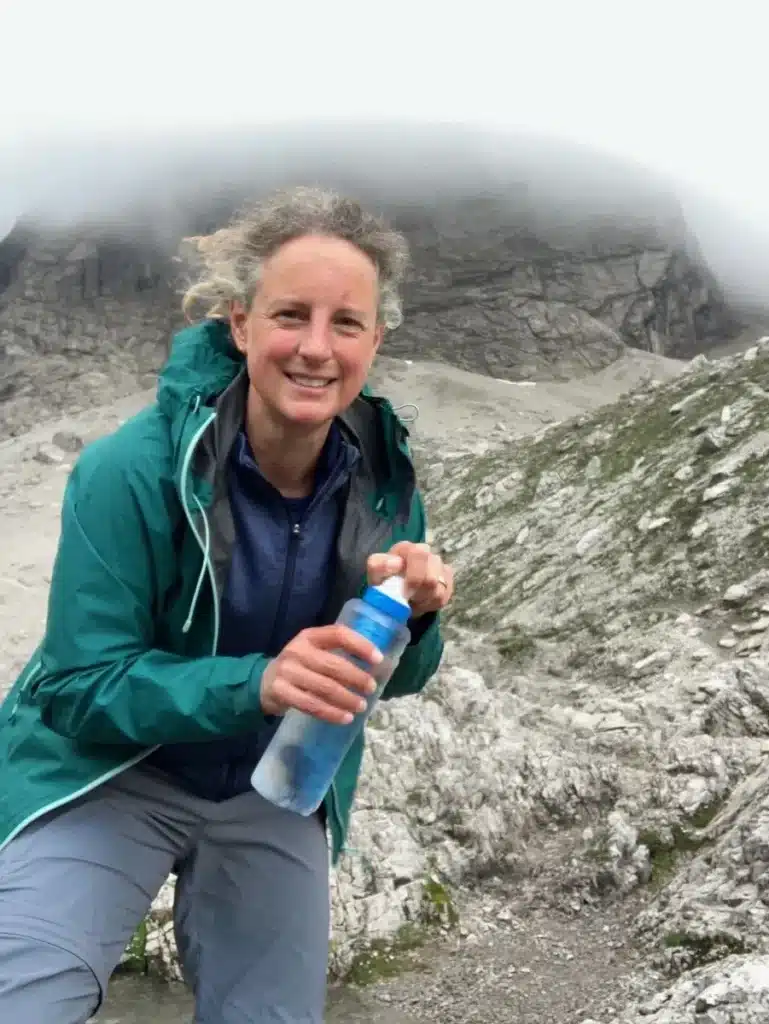
You’ll refill in huts; most have potable water – but do double check this. Carry 1–2 L per person and top up whenever you can. There are often mountain streams along the route, if you fill up, please use a water filter – you don’t know what’s gone in the water upstream, even if it looks beautifully clear!
What should we pack for hut to hut hiking in Austria?
Layers, waterproofs, sleeping bag liner, hut shoes, head torch, power bank, small first-aid kit, and both Komoot offline maps and a paper map. Keep it to 10–12 kg for adults; much less for kids.
Do we need Alpine Club membership?
No, but I recommend it! ÖAV membership usually gets around €10 pp off your overnight and includes worldwide mountain rescue insurance. There’s a Britannia section for UK residents.
Is luggage transfer available?
This isn’t typical for true hut to hut hiking in Austria. Pack light and carry what you need; being self sufficient is half the adventure!
Can I navigate by phone only?
Yes — if you download offline maps and carry a power bank. But just in case your phone dies, bring a paper map as backup. Don’t rely on maps which need a phone signal – it’s often very patchy.
What’s the plan if a storm is forecast?
Start early, aim to finish by mid-afternoon, avoid ridge sections late in the day, and listen to hut staff. If things turn, descend from exposed ground and wait it out. (In an emergency, dial 112.)
Is hut food vegetarian / vegan friendly?
Vegetarian is common; vegan is improving. Mention dietary needs in your booking email and again on arrival.
Are the Austrian routes less crowded than the Dolomites?
100% yes! You’ll meet hikers and there’s a pleasant buzz at the huts, but you won’t get the huge crowds of day trippers and queues for view points that you’ll (unfortunately) see in the Dolomites!
How family-friendly are Austrian huts?
They are all happy to accept kids, and in fact many are more than welcoming; they genuinely encourage families. Some of the smaller alms and huts are especially kid friendly — with play corners, animals to fuss over, sandpits, trampolines and playgrounds. Private rooms make life easier with kids; book early.

Do I need a sleeping bag?
No – usually just a sleeping-bag liner. Huts provide blankets (often duvets and sheets in private rooms); liners keep bedding clean and are required in dorms.
What about showers and sockets?
Showers are usually timed via a paid token (buy at reception); sockets are few. Bring a microfibre towel and a power bank, and be polite about sharing plugs.
Plan the rest of your Austria trip
A 2–3 day hut to hut hiking in Austria mini-adventure sits perfectly in the middle of a bigger trip. We have bookended our hikes with a variety of other adventures – all of which can be done without a hire car.
- Vienna → Croatia by sleeper
Finish your time in Austria with a night train that takes you all the way to the Adriatic while you sleep. You can board the train in 2 other places in Austria closer to the mountains before crossing the southern border. Kid-approved novelty. Read: Vienna to Croatia by overnight train. - Austria cycling holiday: the Tauern Bike Path
Ride from waterfalls in the mountains to baroque squares in Salzburg with luggage in your panniers, not your back. Downhill most of the way; ideal recovery legs after hut days. Read: Tauern bike path from Krimml to Salzburg - One week on the Drau cycle path with kids
Gentle gradients, riverside swims. Works brilliantly from Lienz if you’re pairing with the Lienz Dolomites route. Read: 1 week riding the Drau cycle path with kids and Family‑friendly cycle touring in Austria & Italy - An unforgettable family farm holiday in Austria
Swap bunkrooms for barns: mountain views, animals to fuss over, horse riding and breakfasts you’ll talk about on the train home. The farm we stayed at is close to Filzmoos and Wagrain, and would make a great finisher to a brilliant Austrian itinerary. Read: A family farm holiday to Austria - Best Interrail route for active families
Stitch the whole thing together by rail: including hut to hut hiking in the Dolomites → cycling the Drau cycle path → hut to hut hiking in Austria → sleeper train to Croatia → a week on the island of Vis in the Adriatic. Read: Best Interrail route for active families
And if you want a simple base either side of the hike, pick from Salzburg, Innsbruck, Lienz, Großarl, Kufstein or Wagrain — all with straight-forward train/bus links and plenty to do on “rest” days.
Ready to plan your first (or next) trip?
If you’ve read this far, you’re more than ready. Hut to hut hiking in Austria gives you big mountains, well-run huts, reasonable distances, great well marked trails, car-free logistics and – crucially – no crowds. Start with one of the six routes above, check hut opening dates, and send those first booking emails. Thank me when you return!
Your next steps
If you’re in research mode, these are helpful next reads:
- Complete packing list for hut hiking
- The best kids’ hiking gear
- What to expect in Austrian mountain huts
Have a question about hut to hut hiking in Austria? Send me an email or find me via Hut to Hut Hiking with Kids – Facebook group and I’ll do my best to help. See you on the trail!
