


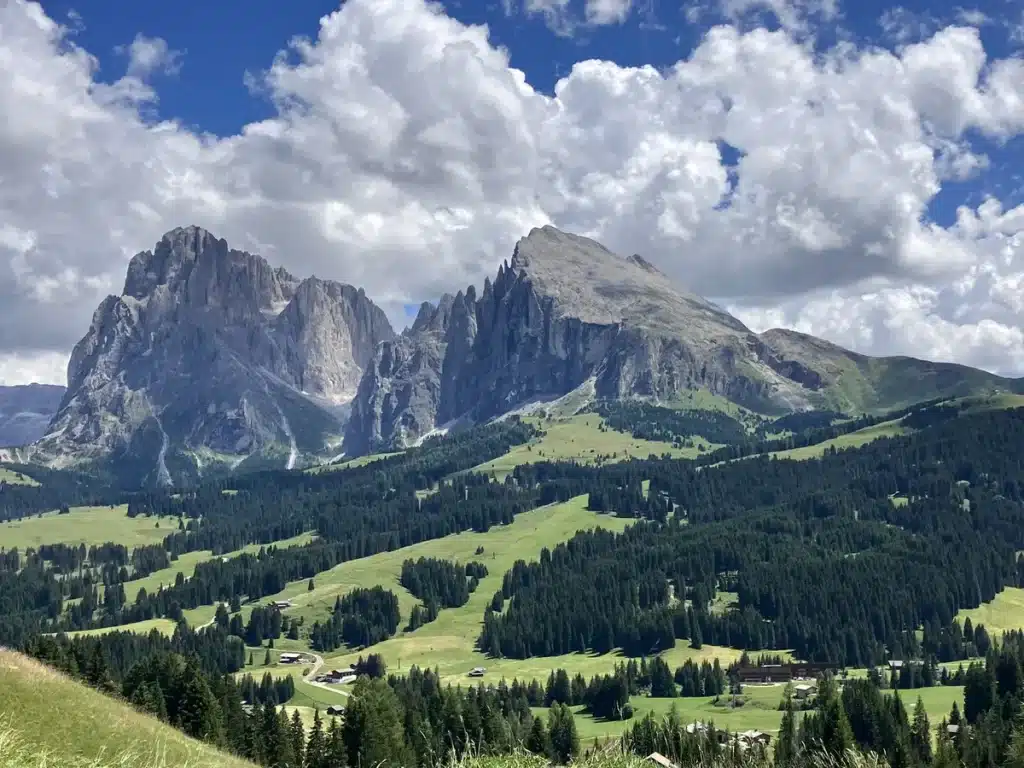
I’d spent a lot of time hiking in Austria, but I’d never experienced that classic Dolomite skyline of saw-toothed limestone towers, glowing honey at sunrise and blush pink at dusk.
So a few years ago, we finally crossed the border (over the spectacular Brenner pass on the train from Innsbruck), for our first hut to hut hike in the Dolomites.
In this guide, I’ll show you exactly how we did it – including route guides for three different but equally spectacular Dolomites hut hikes, how to book the rifugi (mountain huts), and where to stay before and after, without needing a car.
Our first foray into hut to hut hiking in the Dolomites was a route around the famous Tre Cime, which started in Toblach (Dobbiacco in Italian), a village just over the Austro-Italian border, which culturally – and linguistically – feels very Austrian. (Not surprising, since South Tyrol was once part of Austria).
From Toblach, a very easy shuttle bus took us all the way up to Rifugio Auronzo, so reaching the Tre Cime was faff-free; with no need to worry about parking reservations.
We were taken aback by the weather though; it was properly freezing at the top, and we immediately pulled on every warm, windproof layer from our packs!
The hut to hut circuit we planned had short days, was fairly flat and perfect for kids and beginners, but there was no shortage of out-of-this-world scenery. A short wander of a couple of kilometres took us to Rifugio Lavaredo to check in for our first night.
The kids rock-hopped behind the hut while we watched those classic Dolomites walls turn rose gold. As the sun slipped away, the day-trippers vanished, and it was just us and a few fellow overnighters sharing the view.
After this initial experience, I was sold, and since then, we’ve done two more hut to hut hikes in Dolomites.
If you are new to multi-day hiking, the Dolomites is a brilliant place to begin. Days can be as gentle or as punchy as you like; meadow strolls beneath limestone towers or high passes with a bit of scree to keep things exciting.
You eat extremely well; menus include things like polenta with seasonal mushrooms, fried potatoes with local cured ham and fried eggs, apple strudel, and a selection of wonderful cakes. And also, aperol spritz. Evenings are slow; time to chat, play cards, or watch the last light turn the pinnacles pink.
The Dolomites are having a bit of an insta moment, which means some spots, like Rifugio Auronzo (we were super surprised by the amount of people here when we got off the bus on that very first hike!) and the top of the Seiser Alm cable car, can feel a bit like a theme park by day.
The trick is simple; walk beyond the main access points, away from the crowds, and sleep in the rifugi. Most people do not stray far from the cable car or car park, so thirty minutes along the trail the hubbub fades and you get a near private showing of those jagged limestone peaks the Dolomites are famous for. Just know that beds book up fast; I reserve months ahead and recommend you do the same.
Whether you’re hiking with kids or just craving jaw-dropping views and a good slice of apple strudel, this post will help you plan a Dolomites hut trip that fits your crew.
Here’s what you’ll find below 👇
- 📅 When to go
- 🏡 How to book the rifugi or mountain huts
- 🚌 Where to base yourself and how to reach trailheads car-free
- 🗺️ Three tried-and-tested 3 to 4 day routes to choose from (family-friendly and adult-friendly)
- 🎒 Packing & costs to help you feel prepared, not panicked
Ready to map out your first trip? Skip ahead to the sample itineraries.
Disclaimer: This post contains affiliate links. As an Amazon Associate I earn from qualifying purchases. Should you click on a link to purchase, it is at no extra cost to you, but I may receive a small commission, which helps to support this blog (THANK YOU)! See my privacy policy for more information. This post was written (and rewritten!) by Bea – always honest and always based on real-life experience.
What is hut to hut hiking (and why the Dolomites suit beginners)
Hut to hut hiking simply means walking between rifugi (mountain huts) and sleeping in the rifugi in a real bed at the end of each stage.
Dinner and breakfast are either included in the accommodation rate (half board), or available to order, so you’re not lugging a stove or a week of food.
You carry a light pack with just a change of clothes and minimal overnight gear, hike from hut to hut, eat (extremely!) well, sleep, and repeat.
ℹ️ Rifugi translates to “mountain hut”: The word “hut” is a misnomer though!
In the Dolomites, rifugi are more like cosy mountain lodges than basic shelters. Expect:
- A choice of dorms or private rooms (book far in advance for private rooms; bathrooms are usually shared).
- Hearty dinners; often three courses; sometimes à la carte, sometimes a set menu.
- Large breakfast buffets that actually fuel a hill day.
- Hot showers (often at a small cost for a limited time).
- Proper coffee and cake in the afternoon.
- A full drinks menu with beer, wine and even Aperol Spritz. 🍊
- A relaxed, convivial atmosphere where kids and adults feel welcome.
Bring a sleeping bag liner, hut slippers, and cash to pay; usually cards aren’t accepted.

Why the Dolomites make hut to hut hiking easy:
- Excellent infrastructure: well marked and well maintained trails and signposts, and frequent huts.
- Lift access: cable cars and chairlifts launch you straight into the scenery.
- Short, spectacular stages: it’s simple to plan 3 to 4 day itineraries with modest daily ascent that still deliver the big theatre views.
- Good transport: buses and lifts link the popular bases and trailheads, which makes one‑way routes practical without a car.
Tip: If you’re nervous about “big days”, focus on elevation gain rather than distance. For many families and first‑timers, 6–12 km with 300–700 m of ascent is a sweet spot, and won’t be over-doing it.
When to go: best time to go hut to hut hiking in the Dolomites (summer season)
The short answer: late June to late September, with the best time for many families and first‑timers being mid‑July to early September when most huts and lifts are running reliably. The longer answer:
- June: can be glorious, but snow can linger on shaded passes. Some huts open mid‑ to late‑June; check before you plan anything!
- July–August: peak season = full services and busy trailheads. Start early, then walk away from the crowds and sleep high. Afternoon thunderstorms can happen especially in August.
- September: often good weather. Quieter paths, huts still open (many close by the third or fourth week). Shorter days and cooler evenings; bring warmer layers and waterproofs.
- October onwards: a wildcard for planning. A few huts may stay open at weekends, but services wind down fast; early snow and lift closures make logistics trickier.
Booking reality: this region is super popular. For July and August, you need to be thinking months in advance, especially for private rooms. Even dorm beds go quickly especially if you’re looking for beds at the weekend.
Micro‑timing tips for sanity
- Midweek might have more availability than the weekend: you’ll notice the difference particularly at places like Seiser Alm and around the Tre Cime.
- Start early, finish early: beat both the heat and storms.
- Cable car timetables: note first and last lifts (and operation days – some lifts don’t run daily all season!) if your day relies on one.
- School holidays: if you can travel just before or after, do. (We always travel in school holidays though, and you just need to plan early)!
How to book mountain huts (rifugi) without tears
Short version: book early, be clear, and don’t over complicate it. Rifugi owners are friendly, but they’re busy and efficient!
How far in advance should I book Dolomites rifugi?
- July–August: at least 6 months ahead for private rooms; and not much less for dorm beds
- June & September: still book early, but you’ll have a bit more wiggle room.
Where and how to book rifugi for hut to hut hiking in the Dolomites
- Look up the website for the hut.
- If there’s an online booking system, book your beds there and pay a deposit if asked to.
- If not, use the online contact form or a listed email address
- If you’re booking at short notice (especially once the season has already started), you’ll usually need to call them, as hut staff don’t have time (or internet access) for checking emails once they’re up at the hut full time, and a phone call will get you an immediate response.
- Be ready with: dates, number of people, room type (private or dorm), half board (recommended – often that’s the default anyway), and any dietary needs.
Handy email template:
Subject: Reservation request — [Dates] — [Your name]
Hello, we’d like to book [private room/dorm] for [X adults + X children] on [date] with breakfast / half board / a packed lunch.
We can arrive by [time].
Dietary notes: [vegetarian/coeliac/none].
Could you confirm price, deposit, and payment method (cash/card)?
Grazie mille, [Name] | [Phone]
What to expect when they confirm
- Many huts ask for a small deposit (bank transfer or card – they’ll make this clear when you book).
- Half board = dinner + breakfast; lunches are usually paid extra (you can order a packed lunch in advance or when you arrive, or have lunch at a mid way hut on your route).
- Payment: carry cash; a very few huts now take cards, but most don’t still.
Reconfirm one week in advance
- Especially if you didn’t pay a deposit, send a brief reconfirmation email with a short “see you on [date]” note and a time of arrival.
- This helps the hut plan dinner, room allocations, and prevents crossed wires.
Private room vs dorm (and what “private” really means)
- Private rooms are fairly common but bathrooms are still shared.
- Dorms range from 8–40(!) beds; bring earplugs, an eye mask and a sleeping bag liner.
- Showers are often token based – buy a token at the reception for a few minutes of hot water. Showers can be busy – arrive early if you’re keen.

Basic hut etiquette
- Boots off in the drying room; slippers or hut crocs inside. Some huts provide these, at others you should pack a pair of light “indoor” shoes or sandals.
- Bring a sleeping bag liner (blankets provided)
- Observe quiet hours
- If plans change, tell the hut. If you’re overdue or a no-show and unreachable, staff may escalate to mountain rescue, which ties up local teams and can trigger an avoidable search.
- Pack out rubbish unless the hut provides a bin for it.
- Staff are your weather app. If they advise an early start or a route tweak, listen.
More detail here if you’d like it: A beginner’s guide to mountain huts.
Quick checklist before you hit “book”
Where to base yourself in the Dolomites & how to reach trailheads by public transport
If you’re not driving, public transport in the Dolomites works very smoothly. I like a rail‑friendly base, because I really like train travel, and then use local buses (and cable cars if necessary!) to get to the hike start point.
Bolzano (best for the Seiseralm and the Rosengarten)
- Why base here: direct trains from Austria and all over Italy, loads of kid‑compatible food options, and simple and reliable buses into Tiers/Alpe di Siusi. It’s a great spot for a recovery day before/after a hut trip, as there’s loads to see and do here.
- Getting to Seiser Alm: bus 170 from Bolzano to Siusi/Seis then up via the Alpe di Siusi cable car (from Siusi). From the plateau (Compatsch), you’re straight into the scenery.
- Read: 14 Best Things to Do in Bolzano in Italy with Kids for where to stay, and fun things to do and see (tip: Don’t miss Oetzi the Iceman!).
Toblach / Dobbiaco (best for Tre Cime / Drei Zinnen)
- Why base here: straightforward shuttle bus 444 links Toblach directly with Rifugio Auronzo (for Tre Cime). No need to book car parking – much easier to take the bus!

Practical tips for smooth connections
- Check first/last lifts and buses for your start/end points (e.g., Seiser Alm cableway times; shuttle bus timings to the Tre Cime). Build in some slack for queues.
- Buy bus tickets in advance where possible – use the südtirolmobil app (or have cash/card ready for ticket machines or purchasing on the bus).
- Travel midweek if you can; weekends around Tre Cime and Seiser Alm are noticeably busier.
Three short, beginner‑friendly Dolomites itineraries (3–4 days)
These routes keep distances and ascent sensible without short‑changing the views. They work brilliantly with kids and as confidence‑building trips for adult first‑timers or those just seeking a great hike that’s not insanely demanding!
Compare three hut to hut hikes in the Dolomites at a glance
| Route | Days | Total km / ↑ | Start & style | Best base (no car) | Good for | Read more |
| Across the Seiser Alm (Alpe di Siusi) | 3 | 29.5 km / +1,311 m | Lift‑assisted loop on the plateau | Bolzano → Seiser Alm by bus 170, then the Seiseralm cable car | Kids / Beginners with a little more experience. Longer distances, more elevation. | Full guide |
| Through the Rosengarten | 4 | 26.7 km / +968 m | Through the Rosengarten group | Bolzano → St Zyprian by bus 185, then the Cabrio cable car and the King Laurin lifts. | My favourite! Great huts, hugely varied scenery, 4 beautiful days, family-friendly. | Full guide |
| Round the Drei Zinnen / Tre Cime | 2.5–3 | 14.85 km / +671 m | Loop around the Tre Cime (three peaks) | Toblach/Dobbiaco → Rifugio Auronzo by bus 444 | First‑timers, small kids, iconic views, short days | Full guide |

Seiser Alm — 3 days / 2 nights (Alpe di Siusi)
Route at a glance: 29.5 km / 18.3 mi total • +1,311 m / +4,300 ft across 3 stages.
Why it’s ideal: lift‑assisted start straight onto the plateau, rolling trails, wonderful views, great food all along the route.
How to reach: Bolzano → 170 bus to Siusi/Ortisei → Seiser Alm cableway / gondola → Compatsch. Back the same way.
Read the full route: Seiser Alm Hut to Hut Hike with Kids: A 3‑Day Dolomites Family Adventure.

Rosengarten — 4 days / 3 nights
Route at a glance: 26.7 km / 16.6 mi total • +968 m / +3,175 ft across 4 stages.
Why it’s ideal: classic Dolomite towers, steady daily chunks, really exciting terrain and scenery without being too challenging.
How to reach: Bolzano → 185 bus to St. Zyprian → Tiers cable car → König Laurin cable car. Return on foot to St. Zyprian and by bus to Bolzano.
Read the full route: Dolomites hut hiking with kids: 3 nights through the Rosengarten.

Drei Zinnen / Tre Cime — 2.5–3 days
Route at a glance: 14.85 km / 9.23 mi total • +671 m / +2,200 ft across 2–3 stages.
Why it’s ideal: Excellent for little legs and huge scenery for comparatively little effort; evenings go quiet once the Auronzo day‑trippers descend.
How to reach: Base yourself in Toblach/Dobbiaco → buses shuttle line 444 to Rifugio Auronzo.
Read the full route: A Perfect First Hut to Hut Hike in the Dolomites with Kids.
What to pack (and what to leave at home)
Packing for hut to hut hiking in the Dolomites should be light. You’ve got a bed, dinner and breakfast sorted; you just need the layers, the liner and the little things that keep everyone moving and sleeping well. Start with my full list: Complete packing list for hut hiking.
The essentials (families and first‑timers)
- Footwear: broken‑in hiking boots or trail shoes; hut slippers/crocs for indoors.
- Layers: breathable base, warm mid‑layer, waterproof shell, and a warm insulated jacket (evenings can be nippy).
- Legs & socks: quick‑dry trousers / shorts (or zip off trousers); spare hiking socks.
- Sleep kit: sleeping bag liner (required in dorms), base layers,
- Weather & sun: sunhat, sunglasses, SPF, light gloves/buff (early/late season).
- Navigation & power: phone with offline maps, paper map as backup, head torch, power bank.
- Hydration & food: 1–2 L water capacity; snacks you know the kids will eat when morale dips.
- First aid kit including: blister kit (tape/Compeed),
- Admin: cash, ID; Alpine Club card if you have one (not essential).

Free checklist : Grab our kids’ hut‑to‑hut packing list — printable, tick‑off, and tested on the trail. 🎒
Nice‑to‑have (but not essential)
- earplugs and an eye mask if you’re light sleepers
- Lightweight poles (save knees on long descents).
- Microfibre towel & tiny wash kit (showers are token/timed).
- Cards/dice or a pocket game for hut evenings.
For kids
- Keep packs under ~15% of body weight; prioritise keeping them warm/dry over spare outfits.
- If you’re kitting out younger hikers, this roundup is exactly what my kids use: The best kids’ hiking gear (tested on the trail) and Best hiking backpacks for kids.

What to leave at home
- Full sleeping bag (a liner does the job).
- Cook kit (you’re eating in the hut).
- Spare outfits & heavy toiletries
- Bulky toys (go for small travel games instead).
Packing Tips:
- Line packs with a bin liner or dry bag if the forecast looks wet
- Pack the heaviest items close to your back, mid-pack.
- Aim for 10–12 kg for adults on these 2–3 day routes; kids much less.
Costs & booking tips
What hut to hut hiking in the Dolomites costs (ballpark)
- Half board (dinner + breakfast): around €80–€100 per adult; 10 – 20 % discount for kids, depending on hut and room type.
- Private rooms: small premium over dorms; bathrooms are usually shared either way.
- Showers: often €2–€5 for a token (which usually gives you a 2 – 3 minute shower)
- Packed lunch: typically €10–€15 (or buy lunch at the next hut).
- Lunches at huts: €15 – 25 per person depending on appetite and extras like espresso, pudding or alcoholic drinks.
- Membership discounts: some huts offer Alpine Club discounts; ask when booking.
Money tip: carry cash. Most huts don’t accept cards at all.
💸 Does this sound too pricey? It’s true, the Dolomites unfortunately come with a hefty price tag these days. If you hop over the border to Austria, you’ll find fewer people and a substantially cheaper hut hiking experience. The scenery’s still beautiful; rolling meadows, deep valleys and big peaks, but you won’t get quite the same dramatic, saw-toothed horizons the Dolomites are famous for.
Booking tips that save headaches
- Plan backwards from lift / bus timings. Remember the last lift down is non‑negotiable!
- Be specific in emails: room type, ages of kids, half board, dietary needs, arrival time.
- Ask about deposits & payment method up front.
- Confirm the week before with a short “see you on [date]” email.
- If plans change, tell the hut. Being overdue can trigger a mountain rescue callout if staff can’t reach you.
Hut to hut hiking in the Dolomites FAQs
Do I need a guide?
No. These routes are straightforward to navigate with basic hill sense. Trails are well signposted and stages are short. Bring a GPS/phone with offline maps (I like Komoot Premium for offline maps), a backup paper map, and a power bank to keep your phone alive. Check the forecast in advance and be open to changing plans especially if storms are forecast.
Is this just for families?
No — “kid‑friendly” = beginner‑friendly. Shorter days, sensible ascents, big scenery. Ideal if you’re testing the waters as an adult first‑timer.
How fit do we need to be?
Plan for 6–12 km per day with 300–800 m of ascent. If you can handle a hilly 3–5 hour walk at home (with breaks), you’re in range. Expect downtime too: many stages won’t fill a whole day. Enjoy the views (Aperol optional!), play a travel game, or ask rifugio staff about a short side‑hike; Komoot is handy for ideas. Read: How to Get Kids Fit for Hiking Mountains.

How early should I book huts?
For July–August, at least 6 months ahead. Many huts used to open bookings in January for the coming summer; plenty now open even earlier. In short: book as early as you can, the Dolomites are very popular! Read: When to Book Mountain Huts
What about luggage transfer?
Generally not possible as the rifugi are not accessible by road — and honestly, half the fun is being (almost) self‑sufficient. Carry your kit, pack light, and keep it simple.
Are there age limits for kids?
No formal limits. Under‑10s can definitely do this (much younger for the Tre Cime route) if they’re used to hills and you keep the ascent modest. Start early, break often, and choose a short hike like the Tre Cime first. Read: How to Get Kids Fit for Hiking Mountains.

Do we need Alpine Club membership?
I’m a member (and fan) of the Austrian Alpine Club and recommend it. Membership includes worldwide mountain rescue insurance, which is well worth having. You also get reciprocal discounts (often €10–€15 per person) at Alpine Club huts, including many Italian Alpine Club huts; private huts are excluded, so don’t expect discounts everywhere.
Is water easy to find?
Not always from natural sources. The Dolomites’ limestone means a lot of water runs under the rock, not over it, so streams are scarce and water must be conserved. Hut tap water isn’t always potable, but you can buy bottled water or refills at all huts. Carry 1–2 L each and top up whenever you can.
Do huts take cards?
In general, no. Plan ahead and carry enough cash for beds, showers and extras. Card terminals, where they exist, are… temperamental.
Can I navigate by phone?
Yes — download offline maps (e.g., Komoot Premium), carry a power bank, use flight mode while hiking, and bring a paper map as backup. Read: Komoot for Beginners: Why I Love it for our Adventures.
What’s the storm plan?
Start early, aim to finish by mid‑afternoon, and listen to hut staff. If you’re overdue and unreachable, huts may escalate to mountain rescue — always update them if plans change. I use Bergfex for weather reports.
Where should we base ourselves without a car?
Bolzano for Seiser Alm / Rosengarten hikes and easy rail access; Toblach/Dobbiaco for Tre Cime buses.
What games/entertainment work in huts?
Small ones! Cards, dice, a mini notepad. Read: 10 Best Family Travel Games for Lightweight Adventures
Plan the rest of your Dolomites trip
A 3–4 day hut‑to‑hut makes a fantastic centrepiece. Bookend it with one of these easy, public‑transport‑friendly add‑ons:
Bolzano: before or after the huts
- Rail‑friendly, family‑easy, and a handy springboard to the Rosengarten and Seiser Alm by bus + lift. Ideal for an arrival or recovery day: coffee, cake, a gentle stroll, and gelato!
👀 Read my Bolzano guide for places to stay, getting around, and low‑effort day ideas.
Lake Ledro (by public transport)
- A quieter corner of Trentino with clear water, mellow paths and swimming spots — perfect after a few days on the trail. It’s reachable by train + bus connections (no car required).
👀 Plan it with my Lake Ledro post.

Venice (train‑friendly city break)
- Swap limestone towers for lagoon sunsets. Rail links from the Dolomites make Venice an easy follow‑on for a couple of days of gelato, canals and pizza.
👀 See my 24 hours in Venice post for family‑friendly highlights.
Innsbruck (Alpine city palate cleanser)
- Compact, walkable and very mountain‑minded — a nice reset before the journey home. Trains connect efficiently from the Dolomites corridor.
👀 Dip into my The Best Place to Stay in Innsbruck this Summer post for where to stay and fun day adventures.
Adige Cycle Path:
- A wonderful 3 days of mostly downhill and traffic free cycling from the Austria – Italy border. Great bike hire infrastructure: rent bikes in Reschen am See at the start and drop them off when you finish in Bolzano.
👀 Read about our route and how to organise this yourself with my Adige Cycle Path post.

Ready to plan your first (or next) trip?
If you’ve been on the fence about hut to hut hiking in the Dolomites, consider this your nudge. Short 3 to 4 day routes, comfy huts, and big scenery make it ideal for beginners and brilliant with kids — but absolutely not boring for adults.
Book early, pack light, and carry cash. Membership of an Alpine Club is a sensible extra layer of cover.
Next steps:
- Pick a route to start with:
- A perfect first hut to hut hike in the Dolomites with kids (our gentle intro loop).
- Dolomites hut hiking with kids: 3 nights through the Rosengarten (a touch longer, still beginner‑friendly).
- Seiser Alm hut to hut hike with kids (3 days) (alpine meadows + views; more climbing and more distance).
- Sort your base: plan arrival/recovery time with my Bolzano guide.
- Pack light: use the complete packing list for hut hiking, check best hiking backpacks for kids, best hiking gear for kids, and our 10 best family travel games for evenings at the hut.
- New to rifugi? Read a beginner’s guide to mountain huts and when to book mountain huts.
That’s it! Pick a short route, book your beds, and go. 🐝
Have a question about hut to hut hiking in the Dolomites? Send me an email, or find me via Hut to Hut Hiking with Kids – Facebook group and I’ll do my best to help. See you on the trail!
