


Family adventure travel often looks pricey from the outside. I get comments all the time suggesting we must be rolling in money, or that this kind of travel isn’t realistic for “normal” families. I understand the reaction.
But here’s the thing: what we do isn’t about unlimited money. It’s about choosing where we spend our money.
(I also want to caveat all this with – I am aware that we are very privileged. Not everyone can travel like this. I know that, and I make sure my kids know that too).
But if you can afford to book a one or two week package holiday to Turkey or Finland (and A LOT of people do), you can definitely afford to take more adventurous trips like this instead.
I plan carefully, book early, and skip the expensive extras. We stay in youth hostels often (contrary to what you might imagine, these are amazing for families)! We self-cater when we need to keep our food costs down.
We prioritise experiences that are active and outdoors (and as a result often free, powered by our own two feet), rather than ticket-heavy attractions.
That’s how, as family of 4 (with kids aged 11 and 13), we’ve managed 9 winter days in Helsinki and Lapland for under £4,000, and a 2 week Slovenia and Austria adventure in peak August for a similar amount.
This isn’t a post about scrimping or pretending travel costs nothing. It’s about how I build a realistic family travel budget and make deliberate choices so that active, outdoor holidays feel achievable; even if you can only manage one big trip a year.
Disclaimer: This post contains affiliate links. As an Amazon Associate I earn from qualifying purchases. Should you click on a link to purchase, it is at no extra cost to you, but I may receive a small commission, which helps to support this blog (THANK YOU)! See my privacy policy for more information. This post was written (and rewritten!) by Bea – always honest and always based on real-life experience.
What affordable family adventure travel actually means
Affordable family adventure travel doesn’t mean the cheapest possible option. It doesn’t mean squeezing into the tiniest room, never eating out, or saying no to every paid activity.
For me, it means value.
I’m not trying to win a medal for the absolute lowest spend.
I’m trying to build a family travel itinerary, with a budget that gives us the kind of trip we enjoy – mountains, movement, fresh air, and enough comfort that we’re not miserable (honestly, it really doesn’t take much – a comfortable bed to lay our heads at the end of a day’s hiking is usually all we need).
Sometimes that means spending £400 on husky sledding – it’s a bucket list experience, okay?!
But sometimes it means skipping the “must-dos” completely – especially if they’re not really my “must-dos”.
Sometimes it means booking a mid-range hotel with a pool for a few nights in Austria because it’s hot and free access to a pool makes a huge difference.


Other times it means choosing a private family dorm in a youth hostel because it’s half the price, includes breakfast, and the kids get to play ping pong and have space to hang out.
If I start planning a trip, and things start looking wildly overpriced at that stage (as in – just not worth the spend), I don’t try to justify it – I change the destination.
Here’s an example. A couple of years ago I really wanted to go to Yellowstone National Park in the USA. I started planning, got my spreadsheet out.
Flights were not bad for long haul – tick. But then I got to the National Park accommodation. It was SO expensive, and SO crap. Tiny cabins, with two double beds for all four of us, shared bathrooms a walk away, for well over US$200 a night – and with bad reviews.
I just couldn’t justify it. I knew we would all sleep badly and that would have a huge impact on our enjoyment of the whole trip. And at that nightly price over a two week trip – along with having to pay for expensive but crappy fast food at the National Park kiosks / cafes – I knew that wouldn’t be worth it.
The cheaper option was to stay outside the park, but then you have to wake up at 5:30 am to avoid huge queues at the park entrance gates (and to have a better chance of seeing the wildlife).
Neither of these options sounded like a holiday! I cancelled what I’d booked (I only book with free cancellation!), and it’s on the back burner for another time.
That flexibility is what makes this work.
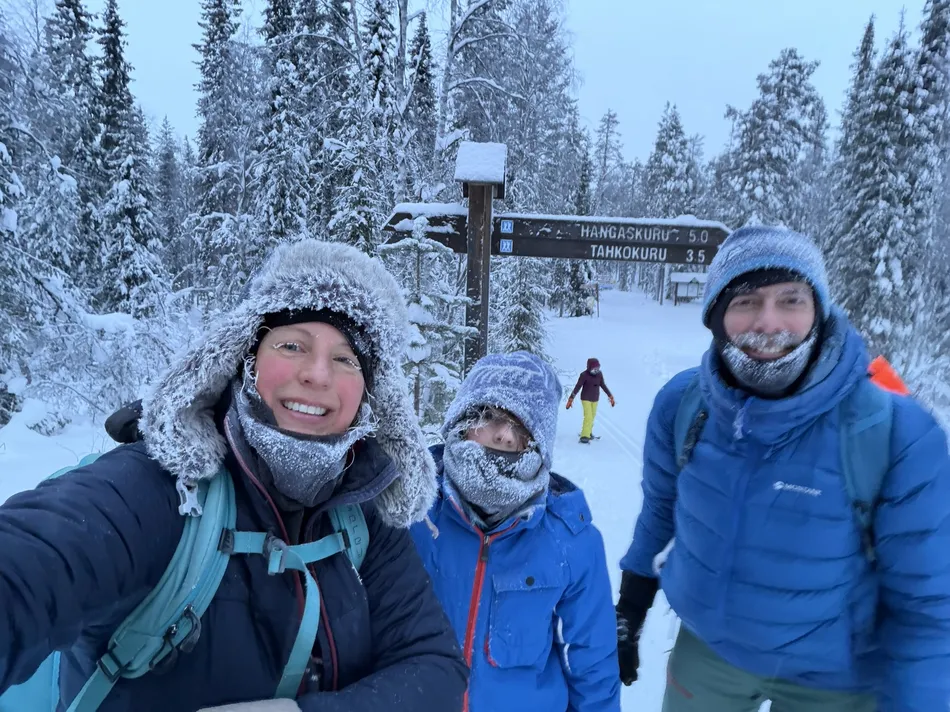
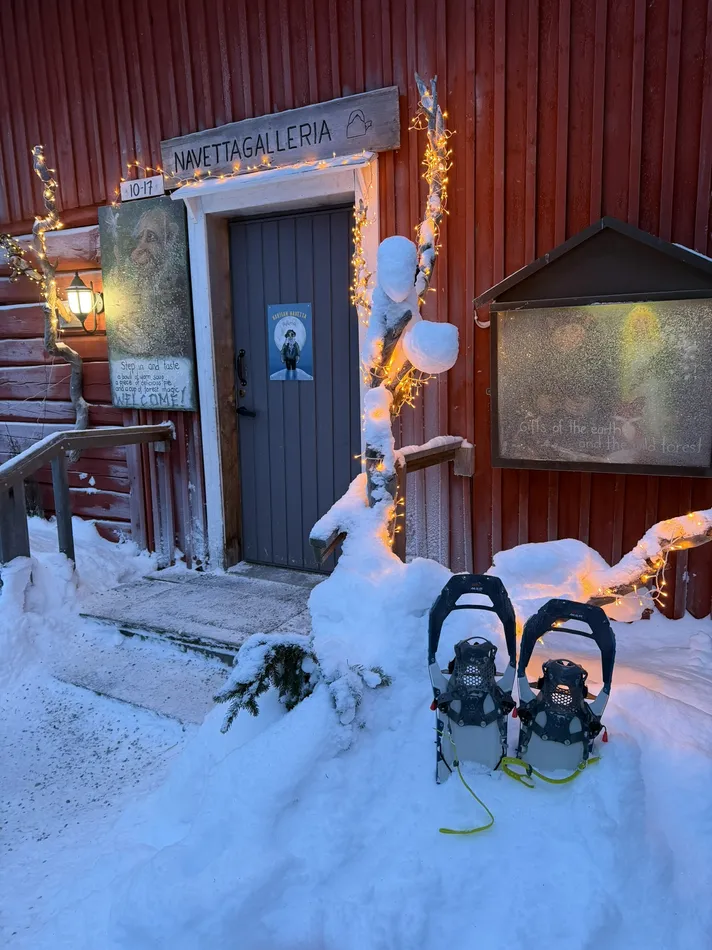
It’s also worth saying this: destinations that have a reputation for being “expensive” often aren’t, once you strip away the packaged extras. Finland is a good example. If you book the Santa tours, snowmobile safaris, and pre-packaged experiences, yes, it becomes eyewatering. If you snowshoe, rent fat bikes for half a day, hike marked trails and cook your own meals, it’s no worse than the UK.
The point isn’t to avoid spending money, the point is to think carefully about how you spend it.
Making family adventure affordable travel isn’t accidental.
I plan it carefully and budget well. And once you understand how to do that, you can apply the same thinking to almost any destination in the world. Just be prepared to shelve an idea if you just can’t make the costs stack up!
For more info about the practical bits that make these trips work, check out my wider family travel tips section; from hut to hut hiking guides and cycling itineraries to packing lists, train travel advice, Easter and half-term ideas and gear reviews.
How to afford family travel: planning & booking strategy
If I’m honest, this is where most of the savings happen. The real difference is made at my laptop, months before we go anywhere.
I do all of the planning. I enjoy it (mostly), and I know that the decisions I make at this stage determine whether a trip feels good value or spirals into something stressful and expensive.
I hate to feel “ripped off” (like when my daughter and I spend €100 on a farm tour in Finland. Yes, we got to see reindeer, Finn horses and huskies, but the whole tour took an hour, if that, we shared it with about 30 other people, and the “igloo” at the end was so full of punters we couldn’t even get in).
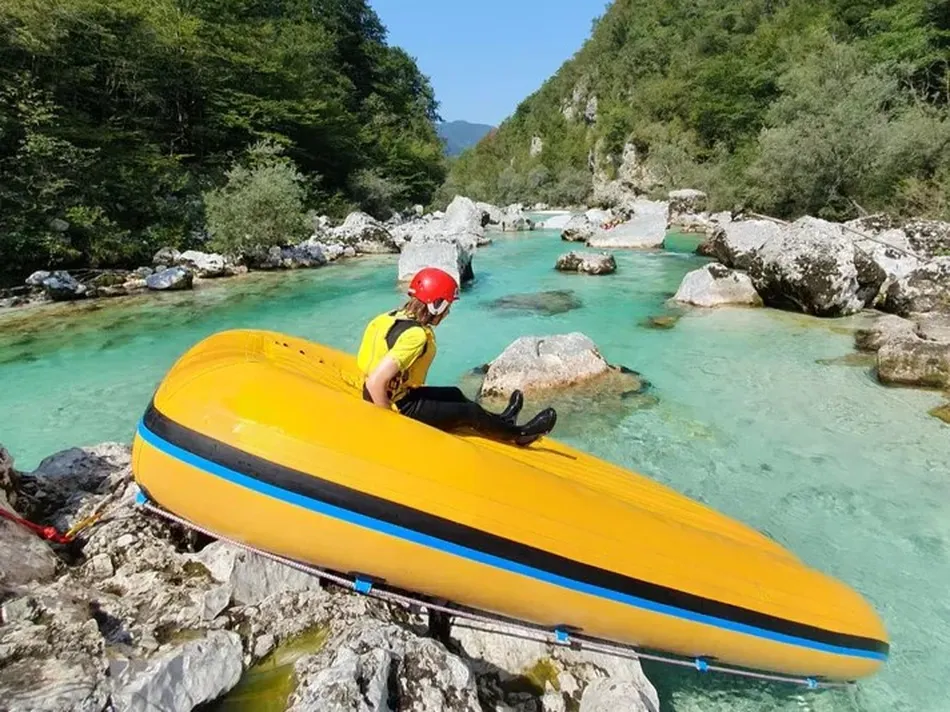
But on the other hand, the €180 I spent on white water rafting the Soča River was excellent value. We had a raft – and a guide – to ourselves, excellent instruction, a really exciting couple of hours’ rafting, and a lot of time to play in the river and have fun. More expensive than the Finnish farm, yes, but way better value!
Book early – but always with flexibility
I very rarely leave big trips to the last minute. Flights, accommodation, sleeper trains – I book as soon as I’m confident about the dates and preferably as soon as they’re released. Prices rarely drop in any meaningful way. In fact, most flights and trains in Europe work on “dynamic pricing” which means the more popular they are, the more expensive they become.
Having said that, I only book things with free cancellation where possible. That flexibility is crucial. If I later realise the numbers don’t stack up, or if something better appears, I want the option to change course without losing money.
A willingness to walk away from something I perceive as “bad value” is one of the biggest financial tools I have.
Avoid peak panic where you can
School holidays limit things, obviously. I’m not pretending otherwise. And we don’t take the kids out of school, so we’re stuck with them! But even within those boundaries, there’s room to manoeuvre.
Not all destinations hike their prices in school holidays, especially if it’s not their peak season. Easter in Mallorca, for example, is far better value than mid-August in the same place, and the weather and terrain is just perfect for hiking at that time of year. February half-term can work brilliantly for Scandinavia trips, often at better value than the immediate post Christmas New Year rush.


When I’m booking flights, I check midweek departures – usually way cheaper than a Saturday flight. I check whether we have inset days (teacher training days where the kids don’t need to be at school – often tacked onto the start or end of school holidays) I can use. Flying home on a Monday instead of a Saturday or Sunday often makes a huge difference.
I compare airports (annoyingly for us, based in Oxford and only 45 minutes from Heathrow, flights out of Heathrow are usually way more expensive than Gatwick – so we often make the trek to Gatwick to save some money).
And if something feels wildly overpriced or bad value during that first spreadsheet session, I don’t try to convince myself it’s fine. I look elsewhere.
There are so many brilliant places in Europe and the world! Don’t force one that clearly isn’t making financial sense.
Travel independently rather than booking packages
Package holidays are convenient, but I generally can’t stand lying by a pool anyway, and when I look at the prices of those holidays compared to what we spend on ours, our trips come out significantly better value (for us, obviously – it does depend what you’re after)!
On our winter trip to Finland, I looked at the standard package companies. Three or four nights, full board, daily organised activities, at well over £1,000 per person. For 3 days!
We don’t need organised activities every day. We’re very happy snowshoeing on marked trails, hiring fat bikes for an afternoon, or using the free cross-country skis provided by our accommodation. We don’t need (or want) a Santa visit. And we prefer to be independent, getting around by public transport, and trying to understand and fit in with local customs.
So I booked flights myself, chose simple but comfortable accommodation with kitchens, added the overnight sleeper train north, and selected one or two paid experiences we genuinely wanted. We stayed longer, spent less overall, and had far more flexibility.
Match transport to the trip
I default to public transport wherever possible. It’s usually way cheaper, often more relaxing, and it removes the stress of navigating unfamiliar roads.

But I don’t force it if it doesn’t make sense.
In Slovenia and Austria, hiring a car was the most logical choice. We were linking mountain valleys, lakes, trailheads and smaller villages. A car made that seamless, and for that specific route it was good value.
In Finland, car hire for Lapland would have cost over £1,000 for the period we needed. Instead, I booked the overnight sleeper train and used taxis carefully for longer transfers. Even with some expensive taxi journeys, it still came in substantially cheaper than hiring a car; and we didn’t have to drive on icy roads in the dark.
There isn’t a single “budget” transport option, but I do tend to default to public transport if I can. It also eliminates the whole “where are we going to park” stress, which can be quite common in small European towns and villages which weren’t built for cars in the first place!
But I do sit down and work out what works best for that specific itinerary before we commit.
Accommodation choices that stretch your budget further
If I had to point to one area where families overspend, it’s accommodation.
Not because you shouldn’t spend money on somewhere nice. But because mid-range hotels, especially in popular areas, can eat a huge chunk of your budget while not actually being that great.
Why hostels and simple stays often beat mid-range hotels
We stay in youth hostels regularly. And I know some people still picture sticky floors and gap-year chaos, but honestly, most of them are brilliant for families.
A private family dorm often gives us way more space than a hotel room. Everyone gets a proper bed (instead of kids squeezing onto a sofa bed in a plush hotel). There’s usually a table, storage, and often even a private bathroom. Breakfast is often included. And the communal areas – games rooms, table tennis, outdoor space – are actually designed for people (and kids!) to hang out in.
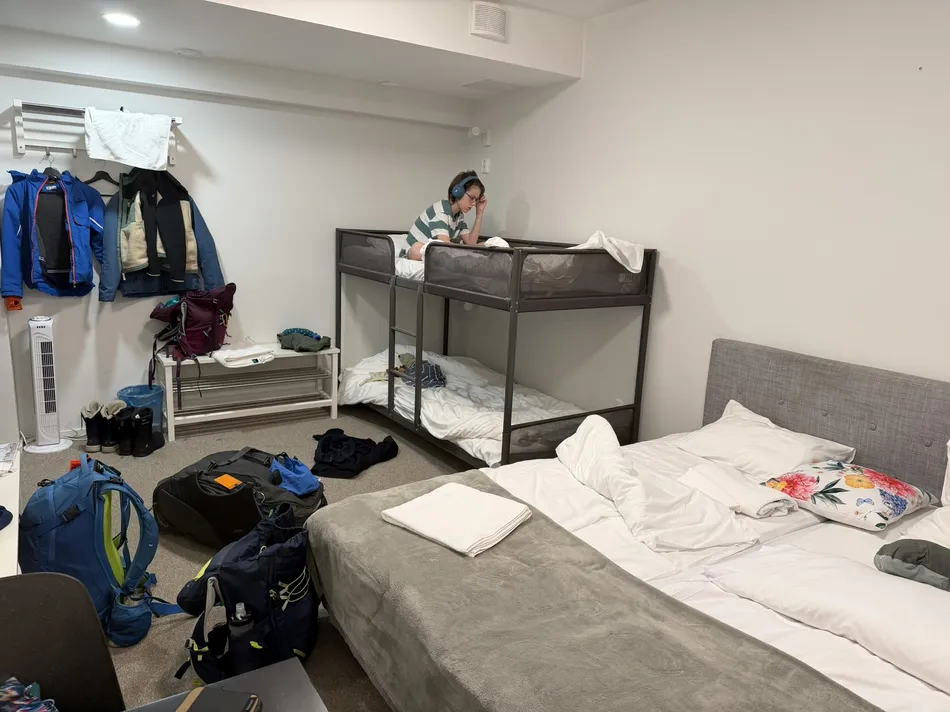

Compare that to squeezing into one standard smart hotel room with a sofa bed wedged in, the kids tired and grumpy because they don’t do well sleeping in such close proximity to each other, and nowhere to hang wet hiking gear – hostel EVERY. TIME.
On one of our regular trips to northern Italy and the Dolomites, we stayed multiple times at a hostel in Bolzano that is genuinely better than many of the guesthouses we stayed in on the same trip – cycling the Adige cycle path. Air conditioning in a heatwave. Huge breakfast spread. Proper beds for everyone. Space for the kids to disappear and play table tennis.
And it was significantly cheaper. Hostels are amazing, please don’t discount them, even with little kids! They are so family friendly these days, and we always see other families enjoying them too.
Self-cater strategically – not rigidly
The cost of food is another aspect we control depending on the trip.
Eating out for dinner in much of Europe can easily cost €100–150 for the four of us if we’re having mains, a couple of beers, and maybe a dessert. There’s nothing outrageous about that; it’s just the reality.
So we tend not to eat out every night.
If you’re really looking to keep the budget down, the best thing to do is book accommodation with a kitchenette or shared kitchen and self cater. Picnic lunches are easy wins too.
At home, we cook most meals from scratch anyway (not because I love cooking – I actually really don’t – but because it saves a huge amount of money over time). That habit makes it easy to slide into self-catering on holiday, but I’m not rigid about it, especially because when we’re on holiday we don’t want to be slaving away over a hot stove every evening!
If we’re somewhere special and we really want to sit outside with a cold drink while someone else cooks, we eat out. If it’s been a long hiking day and I cannot face chopping onions in a tiny apartment kitchen, we eat out.
But you could choose not to eat out at all, if you had a really tight budget. Or, like we do when we’re skiing, we always make a picnic lunch, and then mix take-away pizza nights with self catering in the evenings. Either way, it’s still going to be a great holiday!
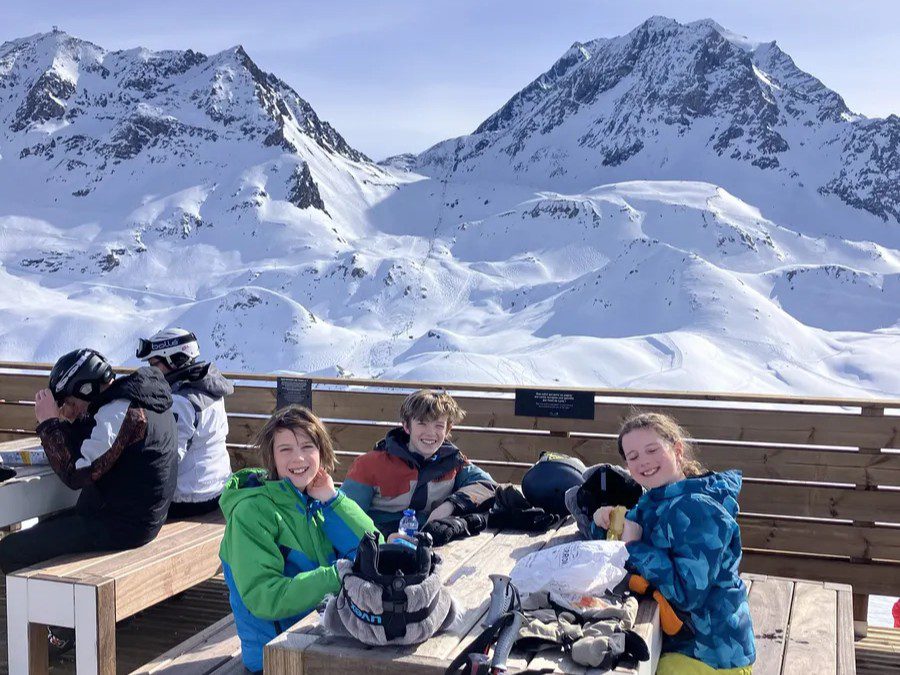
Accommodation and food together are usually the biggest controllable parts of the budget – so control them in a way that suits you.
Affordable outdoor holidays for families focus on nature, not tickets
One of the main reasons this style of travel works financially is because the core of it is simple.
We hike.
We cycle.
We swim in freshwater lakes.
We explore towns on foot.
We take trains through beautiful landscapes.
None of that requires an entrance ticket.
Active, outdoor trips are naturally good value because the “entertainment” is built in. A mountain trail doesn’t charge you per hour. A lake doesn’t require a wristband (usually)!

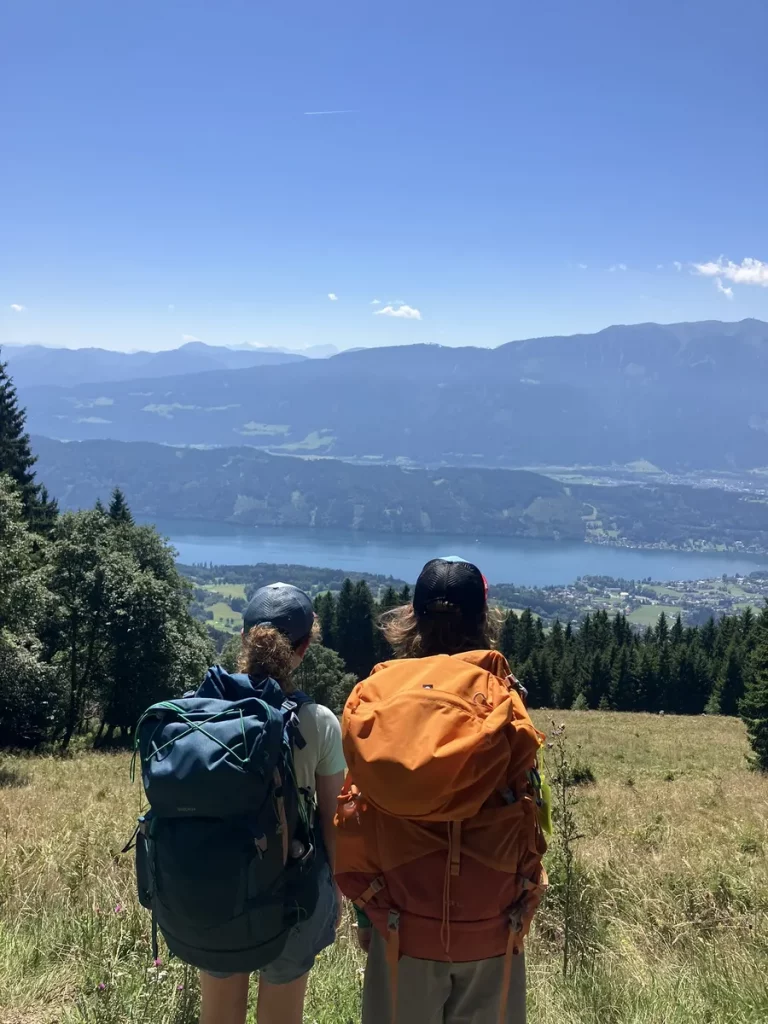
That doesn’t mean we never pay for activities. We absolutely do – when it is worth the experience.
On our winter trip to Finland, we paid for fat bike hire one morning and it was brilliant – but we didn’t book a guided bike tour, which we could have, we just followed a map independently. This was substantially cheaper, and was better for us with kids anyway, as we weren’t worried about whether they would keep up with a group.
On our Slovenia trip, we went rafting and canyoning in the Soča Valley, which wasn’t cheap – but both were a proper adventure and worth every penny.
But we don’t build the entire itinerary around paid experiences, we usually choose one or two standout activities to splash out on.
If you’re structuring a trip around daily excursions; guided tours, attraction tickets, organised experiences, the costs can multiply quickly. But if you’re structuring it around simply enjoying the outdoors, the costs stay contained.
This is why hut to hut hiking works so well. You pay for your bed and your meals (which is often not the cheapest accommodation due to the remoteness of their locations), but the walking in between is free.
Multi-day cycling routes are the same, although you do pay for bike rental if you haven’t brought your own.
Mountain towns in Austria, Slovenia and northern Italy all give you swimming, walking trails, and playgrounds without needing to book anything in advance.
And often, your trip actually feels more authentic because you’re doing more of what the locals do, and removing yourself from the tourist traps at the same time.
If you’re looking for ideas that naturally lend themselves to this kind of structure, I’ve written in detail about:
- Hut to hut hiking with kids
- Multi-day cycling routes in Austria and Italy
- Hiking parts of the GR221 in Mallorca
- Lake-based adventures in Northern Italy
Those types of trips are inherently easier to scale up or down financially because the core experience isn’t ticket-based, and that’s a big part of how affordable family adventure travel becomes realistic.
The gear question: Decathlon vs premium brands
I am not anti-premium brands. If you love them and you use them constantly, brilliant. But you really don’t need very technical, very expensive gear to do outdoor travel properly, especially for growing kids.
You just need sensible layers – many of which you probably already own if you spend any time outdoors or exercising.
Most of our core gear comes from places like Decathlon and Mountain Warehouse. It’s durable, functional, and priced very competitively.
The kids grow. Quickly. I’m not buying them £250 jackets that last six months before the sleeves are halfway up their forearms. We buy good-quality, mid-range kit that keeps them warm and dry.
For winter trips, layering matters far more than anything else. Thermal base layers, fleece or mid-layers, plus a good warm waterproof outer layer (top and bottom). Hat, gloves and decent boots. That’s all you need – and you don’t need multiple changes either. Two sets is plenty.
The same applies to hiking in summer. You don’t need ultra-lightweight, carbon-fibre trekking poles and a £300 backpack for your child’s first hut hike. A well-fitting, comfortable pack from a reliable mid-range brand is absolutely fine. And I’ve said this before – but we built the kids’ kit up gradually. Their first few hut to hut hikes were in cotton joggers. Not ideal if they get wet (slow to dry and chilly), but with waterproof overtrousers just in case, it worked fine. I have a guide to good value kids’ hiking gear here.


Where I don’t cut corners is footwear. If we’re walking for days, I make sure everyone has properly fitted hiking shoes or boots that have already been worn in. Blisters are expensive in a different way!
But beyond that, yes remember – better gear does not equal a better holiday! Comfortable, functional and even better, pre-owned, is usually the most affordable option of all.
The lifestyle choices that fund our travel
This is the bit that isn’t very glamorous, but it’s probably the most important.
When some people (mostly on social media…) see our trips, they tend to assume there must be some secret pot of money somewhere. But there isn’t. We work hard at jobs which earn decent money, yes, just like other people, but most importantly, we’ve made travel the thing we prioritise over lots of other stuff.
We don’t live extravagantly at home.
We have one second-hand car between us and have never felt the need to upgrade it just because it’s a few years old.
We were careful not to overstretch ourselves on a massive mortgage.
We rarely eat out. I cook most meals from scratch – not because I’m a domestic goddess (I really am not), but because it saves a surprising amount of money over a year. And I meal plan – which alone cuts down so much waste.
Our kids go to our local state school, so their education is free. They walk to school.
None of this is exciting or special, it’s just how we live. But when you add it up over twelve months, it creates a decent chunk of space in the budget.
Travel is the thing we choose to spend our money on!
Some families spend more on cars, or private education. Some spend on home renovations. Some eat out or get take aways every weekend or book several short breaks a year in nice hotels. We’re not sitting at home in the dark eating lentils so we can afford flights. It just means we’re clear about what matters most to us and budget our finances accordingly.
And because I build our travel budget intentionally, I don’t then feel stressed when we’re away. If I want to eat out after a long hiking day because I cannot face cooking, we eat out. If there’s an activity we genuinely want to do, we do it. The money for that has already been thought about.
These trips are the result of lots of small, consistent decisions over time.
And if you can only manage one big trip a year, that principle still works. It might mean saying no to other things for a while. It might mean choosing a simpler version of the trip, or self catering more than eating out (that’s fine, the holiday will still be amazing)!
If you can only manage one big trip a year
I know not everyone is doing five or six trips a year. And actually, even for us that only really ramped up once the kids were older and managing school without being constantly exhausted, we were saving a bit more money as a family, and life felt a bit less chaotic.
So if you’re looking at this thinking, “This all sounds great, but we can realistically do one proper trip a year,” that’s absolutely fine – all of this advice still stands.
In some ways, it makes the planning even easier.
When there’s only one main adventure on the calendar, you’ve got time to look into all the different options – travel, transport, accommodation, eating, activities – properly, to make sure it works for you and your family.
One thing I’ve learnt is that active trips give you more “depth” per day. If you’re hut hiking, cycling between towns, swimming in lakes, and exploring on foot, you don’t need constant paid attractions to feel like you’re getting your money’s worth. The days feel rich because you’re doing things and working them out yourselves, not just moving between expensive experiences guided by someone else, or lying by the pool.
I also prefer (and it’s cheaper overall because you’re not multiplying travel costs) to build variety into one longer trip rather than taking multiple short ones – if you can manage the annual leave (or take parental leave if you’re in the UK). A few days hiking in the mountains, some cycling, lakes for swimming, plus overnight trains to get you further afield. Our big interrail route from London to Croatia is a good example of this.

And if the budget is tighter, I scale things back; not the adventure itself, but the extras. Fewer paid activities, more self-catering and less eating out, simpler accommodation, and slightly less prime (or off peak) locations.
Structure your adventure around landscapes and movement rather than tickets and tours, and you can dial the budget up or down without losing the heart of it.
FAQs about affordable family adventure travel
Is family adventure travel really affordable?
It can be, yes, if you build it around landscapes, movement and simple accommodation, it’s often comparable to (or cheaper than) mainstream package holidays. If you build it around daily tours, peak-season flights and premium hotels, it won’t be.
The structure matters more than the destination.
How much should a realistic family travel budget be?
There isn’t a universal number, and I don’t think it’s helpful to pretend there is.
For us, a 7–14 day European trip usually costs somewhere similar to what many families spend on a package holiday during peak season. Sometimes a little more, quite often less, depending on flights and timing.
Is it cheaper to book a package holiday or plan independently?
Sometimes packages are good value. Especially if you genuinely want full board and daily organised activities.
But if you’re unlikely to use everything included, or want more of an adventure, planning independently gives you way more control and better overall value. You can choose simpler accommodation, cook some meals yourself, and pay only for the experiences you actually care about.
That flexibility is usually where the savings are.
Are hostels actually suitable for families?
Yes. Genuinely.
Many modern youth hostels are designed with families in mind. Private family rooms or dorms, proper beds for everyone, shared kitchens, big communal areas, and often breakfast included. In most cases, they function far better than a standard hotel room with a sofa bed or two squeezed in.
It’s always worth reading reviews carefully, but don’t dismiss them automatically.
How do you afford family travel without it feeling stressful?
For me, it comes down to two things: planning early (which I honestly enjoy!) and being honest during the planning stage.
If the numbers look uncomfortable – either it’s coming in above my ceiling budget, or it just really doesn’t feel worth the cost, I adjust (or completely ditch!) the plan.
I’d rather tweak the trip beforehand than feel financially stretched while we’re there.
So how do we keep affordable family adventure travel realistic?
If you’ve read this far, you’ll have realised there’s no secret discount code.
Affordable family adventure travel is about deciding what matters most, planning carefully, and being willing to adjust when something doesn’t stack up.
I choose destinations that give us a lot of “free” value — mountains, lakes, trails, public transport adventures. I book early, keep everything flexible, and walk away if the numbers start looking silly. We stay in really simple (but still comfortable) places. We self-cater when it makes sense. We pay for the experiences we genuinely want and skip the ones we’re not that interested in – even if other people claim they’re “must-dos”.
And at home, we live in a way that saves money for that. If you can afford a mainstream package holiday, you can probably afford an active, independent trip instead. It will definitely involve a lot more planning and admin. But it doesn’t have to be more expensive – and I think it will be a much richer, more enjoyable experience.
If you’re ready to start mapping something out, head back to my family travel tips section and dive into the specific guides — hut hikes, cycling routes, train journeys, packing lists. That’s where the detail lives.
🧭 Read more: practical ideas for your next adventure
If you’re in planning mode and want something specific to get your teeth into, start here:
- 10 Brilliant Easter Holiday Ideas for Outdoorsy Families
- 6 Brilliant October Half Term Ideas for Adventurous Families
- 6 Epic Outdoor Travel Adventures in Europe with Kids (No Theme Parks!)
- Why Our Cycling Holiday in Austria Beat Centre Parcs for Active Families
- Taking Unpaid Parental Leave for Family Travel: How to Travel More as a Family
- Hut to Hut Hiking with Kids | Real Advice & Best Routes in the Alps
