


Interrailing to the south of Spain with kids sounds like a big trip; and honestly, it is.
You’re crossing multiple countries, dealing with a few long train days, and navigating a system that isn’t always as simple as just hopping on and off. It’s very different from the short Interrail loop around Northern Europe that we did a few years ago!
But after taking this exact journey from the UK all the way down to southern Spain with my two kids (aged 11 and 13), I can say this: it’s absolutely doable; and and hugely enjoyable.
Instead of flying, we travelled overland through France into Spain, stopping in Paris, Barcelona and Córdoba (in time for Semana Santa – Holy Week – which was hands down the most memorable part of the whole trip!), before ending on the Atlantic coast for a week of surfing.
And while there were a few things I’d definitely do differently, the experience of watching the landscape, culture, weather, architecture and even the food shift as we travelled south was completely worth it.
If you’re thinking about interrailing to Spain with kids, this guide will walk you through:
- our exact route and itinerary
- what the long train days are actually like with kids
- the real costs (including seat reservations)
- what worked, what didn’t, and what I’d change next time
So you can decide if this trip is right for your family, and plan it with confidence if it is.
Disclosure: Interrail provided our passes for this trip. As always, I only share experiences I genuinely think are useful for families planning their own adventures.
Disclaimer: This post contains affiliate links. As an Amazon Associate I earn from qualifying purchases. Should you click on a link to purchase, it is at no extra cost to you, but I may receive a small commission, which helps to support this blog (THANK YOU)! See my privacy policy for more information. This post was written (and rewritten!) by Bea – always honest and always based on real-life experience.
Is interrailing to Spain with kids worth it?
If you’ve already done a shorter Interrail trip, like our first week-long interrail trip in Northern Europe, or are considering one, this is the next step up.
Our first route stayed relatively close to the UK, with short travel days and easy connections. This one is different. You’re covering a much bigger distance, with a couple of longer train journeys along the way, and heading properly into southern Europe.
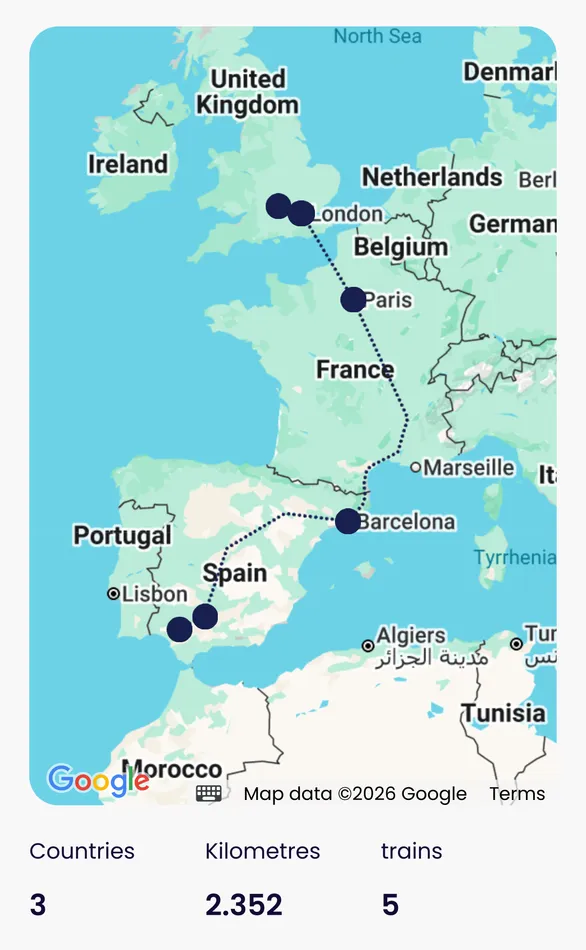
The travel days are longer (in our case, up to around 6 or 7 hours), and there’s a bit more planning involved, particularly because France and Spain require seat reservations on most high-speed trains, even with an interrail pass – lots more info further down this article here. (Some countries are more “pass-friendly” than others when it comes to paying for seat reservations on top of the rail pass. Unfortunately France and Spain are not!)
However, it’s still very manageable, especially with slightly older kids. Mine were 11 and 13 on this trip, and while the journeys were longer than anything we’d done before, they handled them without any issues.

What makes this route really worthwhile is the payoff. You’re not just hopping between nearby cities; you’re travelling all the way from the UK to the south of Spain, with a real shift in climate, culture and pace along the way. And when you leave a 15°C England, and find yourself in 27°C Córdoba in the middle of Holy Week, having got there entirely overland, it’s a great feeling!
If you’re still getting your head around how train travel in Europe works in practice, I’ve put together a full set of train travel guides covering routes, booking and what to expect along the way.
What bags did we use for our family interrail trip to Spain?
For this kind of trip, with multiple trains, using metros in big cities, and cobbled streets, backpacks made things much easier.
We travelled with:
- An Osprey Renn 65 (me)
- Osprey Ace 50 packs for the kids
We didn’t fill them to their maximum capacity, but having a good bit of space makes things easier if you don’t have to pack perfectly each time! There was nothing fancy in terms of packing strategy – but we didn’t pack much, and relied on being able to find laundry after about 6 days.

Backpacks worked well because:
- Easier to manage on and off trains
- Keeps our hands free
- No dragging suitcases through busy stations or cobbled streets
- Much simpler when navigating public transport with steps etc
Our interrailing to Spain with kids itinerary
This is the route we took to get from the UK down to southern Spain by train.
It took us just under a week to get there, travelling over a few days and then spending time in each place along the way.
| Day | Route | Notes |
|---|---|---|
| Day 1 | Oxford → London → Paris | Afternoon Eurostar, overnight in Paris |
| Day 2 | Paris → Barcelona | High-speed TGV train (6h 50m) |
| Day 3 | Barcelona | Sightseeing and exploring |
| Day 4 | Barcelona → Córdoba | High-speed Iryo train (~5h 30m) |
| Day 5 | Córdoba | Semana Santa + activities |
| Day 6 | Train to Seville (~1 h). Car rental from Seville train station and drive to Conil / El Palmar | Start of surf week 🌊 |
A couple of things worth knowing upfront:
- For various reasons, we couldn’t leave the UK until Monday, and had to be in Conil / El Palmar on Saturday, so our time was pretty tight. I’d probably choose to ease the pace up a little with more time to spare.
- This route includes two longer travel days, particularly Paris to Barcelona.
- Once you’re in Spain, trains are fast and comfortable, but seat reservations are required on most routes.
- You don’t have to follow this exactly! There are a lot of variations you could do – like spending longer in each place we stayed in, adding a stop in the South of France (Montpellier, Béziers, Narbonne or Perpignan), or adding another stop (or two!) in Spain, like Zaragoza or Madrid.
We flew home at the end of the trip, mainly because we didn’t have time to do the journey in reverse; and in reality, I probably wouldn’t choose to. It’s a long way to retrace your steps, and it’s not the easiest route to turn into a circular journey with limited time.
Books and travel inspiration
For Paris:
- Lonely Planet Kids: A Kid’s Guide to Paris (good for building a bit of excitement before arriving)
- Lonely Planet Pocket Paris (small enough to carry, but still useful for quick planning)
For Barcelona, these worked really well:
- Lonely Planet Kids City Trails – Barcelona (great for introducing Barcelona to younger kids)
- The Mini Rough Guide to Barcelona (compact, practical, and easy to dip into)
And for the southern Spain leg:
- Rough Guides Andalucía (helpful for understanding the region and planning)
- Wild Guide Andalucía (more focused on outdoor spots, hidden places, and getting slightly off the beaten track; much of this you’d need a car for)
We didn’t carry all of these around with us, but they were useful in the lead-up!
Day 1 | Oxford to Paris by train (and what I’d do differently)
We took a fairly relaxed start to the trip, getting the train from Oxford into London and then catching a later Eurostar to Paris.
On paper, this worked well. No early start, no rushing, and an easy journey down to London.
In practice, it created a bit of a knock-on effect.
Because we arrived in Paris late (7 pm), we didn’t really have any time to enjoy it. It ended up being a pretty expensive overnight stop for what was essentially just a place to sleep before an early start the next morning.

And that early start? Was quite hard work, especially with the 1 hour time difference between the UK and France.
However, we found a good hotel to lay our heads very close to the Gare de Lyon (where the Barcelona train departs from), and enjoyed a great crêperie for dinner.
👉 Where we stayed in Paris
ibis Paris Gare de Lyon Ledru Rollin
- 5-minute walk from Gare de Lyon (ideal for an early onward train)
- Less than 30 minute walk to Notre Dame and the Latin Quarter
- Nice outdoor area
- Good breakfast (optional)
- Quiet, comfortable rooms with everything you need
- Plenty of cafés and restaurants right nearby
- Easy metro access for getting around the city
It’s not the most characterful place you’ll ever stay, but it’s clean, calm, and genuinely nice.
If anything, it felt too good for a one-night stop where we basically just slept. If you’re planning to actually spend time in Paris, this would be a really solid option.
To get from the Gare du Nord to the Gare de Lyon, it’s two easy stops on the “D” (green) RER line, which is fairly easy to navigate. Just be vigilant to pick pockets on the Paris metro / RER. Nothing to worry about, but make sure your valuables are out of sight and well zipped up!
What I’d do differently next time!
If I were planning this again, I’d tweak this first leg slightly.
You’ve got a couple of better options:
- Take an earlier Eurostar and actually spend time in Paris
This turns Paris into part of the trip rather than just a stopover, and makes the overnight stay feel worthwhile. I have a whole post about Where to stay, eat and sightsee on a one night Eurostar stopover in Paris! - Skip staying in Paris altogether and continue further south
If timings allow, heading out of Paris immediately from the Gare de Lyon to Valence Gare TGV, which is the first stop on the Paris to Barcelona train, means you shorten the long Paris → Barcelona journey the next day. There’s a great value ibis hotel right at the station which is much cheaper than Paris. It avoids the very early start from Paris the following day and spreads the journey more evenly.
There’s no single “right” way to do this – it depends how much time you’ve got and how your family handles travel days.
But if there’s one thing I’d change from this trip, it’s this first day. A slightly earlier start would have made the whole journey flow a bit better.
A quick note on this train (London → Paris Eurostar)
The Eurostar is one of the most popular Interrail routes, and one of the easiest to get caught out on.
You can use your Interrail pass, but you’ll still need a paid seat reservation, and there’s a strict quota of passholder seats on each train.
- Reservations cost €32 per person (including kids) + booking fee (€4 total with B-Europe)
- You must book a specific departure in advance
- Once the Interrail seats are gone, you’ll need to pick a different train, or buy a full-price ticket
This is especially important if you’re travelling in school holidays, when the limited passholder seats can sell out quickly.
👉 Top tip: Check availability before buying your Interrail pass. The easiest place to do this is via B-Europe, which shows real-time seat reservation availability for passholders; you can do this BEFORE buying your pass. You can also book your seat reservations for the Eurostar on this platform, which I recommend. There’s a booking fee of €4 per order (not per person).
Day 2 | Paris to Barcelona by train with kids: What to expect
This is the leg that makes most people hesitate, and I understand why.
At just under 1000km and around 6.5 hours, it’s the longest single train journey on the route. On paper, it sounds like a lot, especially with kids.
We took the 07:42 departure from Paris, which meant an early start, but that was 100% the right decision.
Arriving into Barcelona in the early afternoon made a huge difference. We had time to find our accommodation, get settled, and actually enjoy the city that same day, rather than arriving exhausted in the evening.
What the journey is actually like
Honestly? Much easier than expected.
The train is comfortable, smooth, and easy to settle into. Once you’re on board, it doesn’t feel like a “travel day” in the stressful sense; it feels more like enforced downtime.
With kids (and especially on my own with kids!), my approach is to lower expectations and just lean into it:
- no strict screen time limits
- plenty of snacks
- breaks to walk up and down the carriage or to buy something from the on board cafe
- and a lot of time just watching the scenery
And this is one of the best routes for that; the train runs between the Mediterranean and the salt pans on France’s south west coast, and then past the Pyrenees, with some spectacular views.

Can kids handle a 6–7 hour train journey?
Mine (11 and 13) handled it without any issues.
But I wouldn’t approach this the same way with younger kids I don’t think! If yours are under 6 or 7, I’d seriously consider breaking this journey up with a stop in the south of France (Montpellier or Perpignan work well).
👉 Key takeaway:
This is a long journey, but not a hard one. If you choose an early train and treat it as part of the experience, not just a transfer, it becomes one of the most enjoyable parts of the trip.
The journey itself was absolutely fine. Long, yes, but comfortable, smooth, and easy to settle into.
A quick note on this train (Paris → Barcelona)
This is another of the routes where Interrail is a bit less flexible.
The Paris to Barcelona high-speed train requires a seat reservation, and there’s also a limited quota of seats available for Interrail pass holders.
- Reservations cost €35 per person (including children) + booking fee (€4 total with B-Europe)
- You need to book a specific train in advance
- And once the Interrail quota is gone, you’ll either need to choose a different train or pay full price for a ticket
At the time of writing, there are only two direct trains per day, so availability can go quite quickly, especially in school holidays and the peak summer season.
It’s not complicated, but it’s one of the few parts of an Interrail trip where booking ahead really matters.
👉 Top tip: Check availability before buying your Interrail pass. The easiest place to do this is via B-Europe, which shows real-time seat reservation availability for passholders; you can do this BEFORE buying your pass. I also recommend making your passholder reservation for this train on this platform. There’s a booking fee of €4 per order (not per person).
Arriving in Barcelona
Getting in earlier in the day paid off straight away. It took a little time to find the metro station from the main Barcelona-Sants train station. In the end we walked out of the main station and entered the Metro station at street level, a couple of minutes’ walk away, at Carrer de Numància.
Apparently though, it isn’t necessary to go outside the station, simply look for the red diamond with a white M in the middle – the sign for the metro and make your way down the escalator. There’s an underground walk-way to the Metro station. We couldn’t find this!!
We bought tickets from the vending machine at the station. We just bought 3 single tickets, but if you think you’re going to use the metro more, you can buy a “T-familiar” ticket – which is a multi person ticket with 8 journeys loaded on it. Lots of info on fare types here.
Alternatively you can buy a Hola Barcelona travel card in advance, which gives you free travel for a specified number of days. You can buy this online, and then they email you a voucher with a code which you use to pick up your travel card at any metro station.
Kids under 4 travel free, but all other children pay full fare (unless they can prove they’re locals!).
The metro was very easy to use once we’d found it. We travelled a few stops to Plaça de Catalunya, checked into our hostel, and had a little rest before heading out again.
👉 Where we stayed in Barcelona
Bed & Breakfast Barcelona Fashion House
This was a really lovely place to stay.
- Brilliant central location in Eixample, walking distance to a lot of the main sights and the Gothic Quarter
- Spacious triple room with high ceilings and lots of natural light
- Access to a large shared terrace (great for a bit of downtime)
- Quiet, calm feel despite being right in the middle of the city
- Optional good value breakfast (order the night before)
It’s set in a beautiful old building, which makes it a really good balance of interesting + comfortable, which isn’t always easy to find.
Visiting Casa Batlló with kids (is it worth it?)
This was one of our favourite activities in Barcelona, and one I’d absolutely recommend if you’re travelling with kids.
Casa Batlló is one of Gaudí’s most famous buildings, and it feels more like stepping into a storybook than visiting a traditional attraction. There are curved walls, colourful tiles, and almost no straight lines anywhere.
There’s a lot to look at, but Gaudí’s architecture is so accessible for kids. The audio guide is interactive and explains things in a way that actually holds attention.


We booked a late afternoon slot for the day we arrived (around 17:30), which worked really well after a long travel day.
👉 I’d strongly recommend booking this in advance, especially during school holidays. It’s a popular attraction and time slots do sell out.
- Free for children aged 0–12, which is actually a bargain!
- A really well-done interactive audio guide
- Kids get their own headset, but adults should bring headphones and use the app
- The app has some augmented reality elements and slightly surreal “Gaudí-style” storytelling
- Central location, easy to reach on foot
If you’re deciding what to prioritise in Barcelona with kids, this is one of the easiest “yes” decisions. We just paid for the general visit, but you can pay extra (on the spot) to go up to the roof terrace if you want to.
👉 Check availability and book your tickets here
Day 3 | Barcelona with kids
We spent one full day in Barcelona, and ended up doing a lot of it on foot – rather more than planned!
For breakfast we went to Citizen Café Barcelona both mornings (a short walk from our hostel), and it was excellent; I love a good breakfast menu with eggs and avocado options!
We then walked to:
- Sagrada Família (~30 minutes)
- Park Güell (~35 minutes uphill from there)
We paid to go into Park Güell, but didn’t go inside the Sagrada Família itself. You definitely could (and many would say you should – I’m still not sure we did the right thing by missing it, but everything costs money so we couldn’t do it all!) so if you do want to go inside, book ahead!
Book your Sagrada Familia and Park Guell tickets here:

After that:
- Quick, easy lunch (bocadillos – cheap and available in all bakeries / food shops)
- Bus back into the city centre (easy contactless card tap in to buy and validate a ticket – just tap the same card multiple times for multiple people)
- Essential stop at the Lego store (non-negotiable with kids!)
- Afternoon reset at the hostel

Later, we headed out again on foot to explore the Gothic Quarter, which is probably my favourite part of the city.
The reality of Barcelona with kids
Barcelona is brilliant; but it does require a bit more energy.
- It’s busy, especially around major sights
- There’s a lot of walking unless you plan transport carefully
- You do need to stay a bit more aware of your surroundings (pickpockets etc.)
By the end of our time here, we were definitely ready for somewhere calmer.
What worked really well
The Gothic Quarter was a highlight.
It’s a real maze of narrow streets, with street performers dotted around and plenty going on without needing a plan. We used part of a Rick Steves audio tour and map, which gave just enough context without turning it into a full “tour”.
There’s also a brilliant looking walking tour of this area specifically aimed at kids and their families on Get Your Guide; which searches out the city’s dragons with exciting riddles and clues to find your way through the Barrio Gótico. It has fantastic reviews and I recommend booking this one way ahead if you have the time!
We ate tapas in the Gothic Quarter at Mi Burrito y Yo and walked back to the hostel via La Rambla, Barcelona’s main pedestrian street, lined with shops, street performers and plenty going on at all hours.
Book your dragon tour in the Gothic Quarter here
👉 What I’d do differently next time:
- Plan more transport breaks (less walking overload)
- Fully commit to the Sagrada Família (book tickets ahead)
- Add the dragon tour in the Gothic Quarter
- Add a beach stop to balance the busy city feel
👉 Key takeaway:
Barcelona is exciting and full of things to do, but it’s one of the more demanding stops on this route with kids. Plan for downtime and don’t try to do everything.
If we had more time
We didn’t make it to the beach, but it’s an obvious addition if you’ve got longer. It would break things up nicely and give everyone a bit of space after a couple of busy days in the city.
Another good option is heading up to Montjuïc, which is a large hill fort just outside the centre with parks, gardens and great views over the city and the sea. It feels noticeably calmer than the main tourist areas.
You can walk up (if you’re happy with a bit of a climb), or take the Montjuïc Cable Car, which runs up to the top and is an easy win with kids.
If you’re up for something more active, you can also head up to Tibidabo. It’s one of the highest points above the city, and you can walk up through woodland trails before reaching the top, where you’ll find the Fabra Observatory and the slightly retro Tibidabo Amusement Park.
Outside Barcelona
If you have longer, or just wanted to stay somewhere smaller on the coast outside Barcelona, consider Sitges (30 mins by train from Barcelona), or Tarragona (1h 30 by train from Barcelona), both of which have plenty to see and do and decent beaches too.
Day 4 | Barcelona to Córdoba
This was another long travel day.
We took a high-speed Iryo train from Barcelona down to Córdoba, which took around 6 hours.
It’s another long distance (also around 1000 km), but the experience was straightforward. Spanish high-speed trains are modern and comfortable, so once you’re on board, it’s just a case of settling in and watching the landscape change.
A quick note on trains in Spain
Interrail in Spain works a bit differently compared to places like Germany or the Netherlands.
In Spain, almost all long-distance trains require seat reservations – including this one.
- You’ll need to book a specific train in advance
- Reservation on this train cost extra (€13 per person) + €2 pp booking fee on the Rail Planner app
- There’s less flexibility to just “hop on the next train”
It’s not difficult, but it does mean you need to plan this leg a bit more carefully.
For the trains within Spain, the best place to book your interrail seat reservations is directly in the Rail Planner app, once you have your pass. There’s a booking fee of €2 per person. There are quite a lot of trains running this route daily (there are 2 main Spanish operators, Renfe and Iryo, so you have the choice – neither is any better than the other!).
There’s no quota for pass holders on this route, but if the train is full, it’s full! Over the week before Easter the trains really were packed mostly with domestic tourists, so bear that in mind and make your reservations in good time.
Also worth knowing: at major stations like Barcelona, you’ll go through a quick security check before boarding. Bags are scanned, but you don’t need to remove liquids or electronics, and there’s no scanning of your person. It’s generally fast and low hassle.
Arriving in Córdoba
After Barcelona, arriving in Córdoba felt completely different; smaller, calmer, warmer (27°C!), and much more relaxed. We LOVED Córdoba!

We’d timed our visit to coincide with Semana Santa (Holy Week), which meant the city had an amazing atmosphere.
Even just walking through the narrow, winding cobbled streets on that first evening, finding our hostel, you could feel it. The air smelled of incense, there were crowds gathering, and you’d hear drums approaching from one of the holy week processions somewhere nearby.
It felt like we’d travelled a long way – not just in distance, but in pace and culture as well.
🛏️ Where to stay in Córdoba (what I’d do differently)
We didn’t quite get accommodation right in Córdoba.
Where we stayed (Patio de la Plateria) ended up being damp, overpriced, and not somewhere I’d choose again; even though the location was excellent.
If I were booking again, I’d go for something different. These were the places I had my eye on (but were fully booked by the time I organised this trip):
- Cats Hostel Córdoba – private family rooms available, central, and good value if you’re happy with a hostel setup (it even has a swimming pool!)
- Vitium Córdoba – located right in the old town and near the Mezquita without being over the top on price. Family rooms available
- Los Patios Hotel – more traditional Andalusian style, right opposite the cathedral, and with a restaurant. Good value family rooms.
Day 5 | Córdoba with kids: Why it was the best stop on the trip
Arriving in Córdoba on our interrailing to Spain with kids adventure felt like a complete reset.
After the pace and intensity of Barcelona, everything here was slower, calmer, and noticeably warmer (27°C when we arrived).
Within the first evening, we knew we’d made the right choice stopping here.

Why Córdoba works so well for families
- It’s compact and walkable
- The streets are quieter and less overwhelming
- There’s still plenty to see, but without the pressure of a big city
But what made this stop unforgettable for us was the timing.
We arrived during Semana Santa (Holy Week); and it completely transformed the experience.
Semana Santa in Córdoba: what it is (and what to expect)
Semana Santa (Holy Week), is… just an amazing cultural experience. It’s pretty intense, but honestly you have to see it!
Across Andalusia, towns and cities hold daily religious processions in the week leading up to Easter Sunday. In Córdoba, these wind through the narrow streets for hours at a time, with:
- Huge, ornate floats carried by teams of people
- Traditional robes and pointed hoods (which can look surprisingly like the KKK if you’re not expecting them – but it’s a centuries old tradition and absolutely completely unrelated)
- Live marching bands
- The constant scent of incense drifting through the streets
- Crowds lining the streets to watch
It’s intense, solemn, busy, and completely fascinating.

What Semana Santa is like with kids
The parades are hard to miss. You can pick up a leaflet (or find it online) explaining which route each brotherhood will take on each day, but unless you know the city well, it’s not all that easy to work out.
If you just go for a wander, particularly in the evenings, in the old quarter near the Mezquita, there’s no doubt you will find one – follow the drum beats!
Some streets were crowded, and it was hard to see, but other streets weren’t too busy, and we got a great view. I think you just have to go with the flow!
The kids were completely drawn in by it, the music, the drums, the scale of the floats, the slightly surreal atmosphere. The local people are chatty and cheerful and although the processions themselves are quite solemn, and a hush falls when the effigies come past, the overall atmosphere is social and festive.
It’s not a quiet cultural experience you observe from a distance; you’re right in it.
What to know before you go:
- You can easily get stuck on the wrong side of a procession for quite a while. Pack snacks and be prepared to be out pretty late (by this time you should be getting used to Spanish late nights – take a siesta in the afternoon if your kids will hear of it! Mine won’t, but we had a rest at least.)
- Streets close without much warning – but you can usually cross a procession when it stops (they take regular breaks, for the people carrying the enormous floats!). Take your cue from local people though about whether crossing is appropriate. Don’t make a cultural faux pas!
- It gets busy, especially in the evenings on the streets which surround the Mezquita, which are partially blocked by fencing to provide private paid seating for viewing the parades.
It’s worth allowing extra time to get anywhere after about 5-6 pm, or just accepting that plans might shift slightly.
What is the Mezquita (and is it worth visiting with kids?)
The Mezquita of Córdoba is part mosque, part cathedral, and an amazing building. All the holy week processions pass through its church to fulfil their rites of penance.
Originally built as a mosque during Islamic rule in Spain, it was later converted into a Catholic cathedral. Instead of replacing what was there, the cathedral was quite literally built into the middle of the mosque, which makes for a striking combination of architectural styles.

Inside, it’s best known for its endless rows of red-and-white striped arches, which seem to go on forever in every direction. It’s visually impressive in a way that’s quite different from your typical European cathedral.
We didn’t go inside on this trip; because tickets were all sold out by the time I thought about it! In hindsight I wish we had. You can still appreciate parts of it from the outside and surrounding courtyards if you decide not to go in, which we did.
Book your Mezquita tickets here:
What we did in Córdoba
Outside of Semana Santa, Córdoba is an incredibly easy city to explore; compact, walkable, and really beautiful, with winding cobbled streets and typical Spanish and Moorish architecture.
We mixed low-key exploring on foot with a couple of activities that worked particularly well with kids (and broke up the walking nicely).
One of the best things we did was a guided bike tour. After a very step-heavy day of walking in Barcelona, this felt like a much easier way to see more of the city.

It’s a relaxed, family-friendly way to get your bearings; cycling through the historic streets, along the river, and past all the main sights, with enough context to understand what you’re looking at (without turning it into a full history lesson). We booked our tour for 3 pm which worked well at it was siesta time which meant really quiet streets.
Book your private bike tour here:
We also booked the equestrian flamenco show (book this far in advance), which ended up being a real highlight, especially if you’re horse mad, which my daughter is, but we actually all loved it, as it was super impressive.

It’s a mix of traditional Andalusian horsemanship and flamenco, set in an outdoor arena. It was really engaging and atmospheric. The horses and their riders were incredibly talented!
Book your Equestrian show tickets here (these sell out – book in advance!):
The rest of our time was much less structured, wandering through the old town, stopping for drinks when needed (often), and just soaking up the atmosphere.
After Barcelona, Córdoba felt noticeably calmer. Still busy because of Semana Santa, but less intense, less of a big-city feel, no constantly navigating crowds or ticking off sights.
👉 What I’d do differently next time:
- Book accommodation earlier (Semana Santa fills up fast)
- Pre-book Mezquita tickets; it does sell out
👉 Key takeaway:
Córdoba is the perfect balance on this route. It gives you the culture and atmosphere of southern Spain, without the overwhelm of a bigger city like Seville.
Day 6 | Ending our family Interrail trip to Spain (and heading to the coast)
From Córdoba, we took a short train down to Seville which took less than an hour.
Even on this relatively short leg, we still needed seat reservations:
- Reservations cost €15 per person (including children) + €2 pp booking fee on the Rail Planner app
- You need to book a specific train in advance
Why we didn’t stay in Seville
We weren’t particularly keen on diving straight from Barcelona into another big city, especially during Semana Santa, when Seville becomes extremely busy (and expensive).
Córdoba had already given us that historic, atmospheric Andalusian experience, just on a smaller and more manageable scale.
If you’ve got more time, you could absolutely do both!
Swapping trains for surfboards
Instead of staying in Seville, we picked up a rental car directly from the station and headed south to the coast; down to Conil de la Frontera and El Palmar, where we had a week of surfing lessons, which was the whole reason for the journey in the first place!
After this pretty packed six days of cultural experiences, with over 2,300 kilometres of train travel under our belts, a full week by the sea balanced things out nicely.
👉 Surf trip blog post coming soon
We did end up flying home from Seville, simply because we didn’t have the time (or, if we’re honest, the desire) to retrace the whole route back north by train.
Interrail in France and Spain: what you need to know
If you’re planning to use Interrail through France and Spain, it’s worth knowing upfront that it works a little differently here compared to some other parts of Europe.
The trains themselves are fast, comfortable, and easy to use, but because the French and Spanish rail systems are not especially pass-friendly, a bit of planning goes a long way.
Interrail passes: the basics
An Interrail pass gives you a set number of travel days within a fixed time period (for example in this instance, we had a 4 days of travel within 1 month pass).
On each travel day, you can take as many trains as you like – it all counts as a single travel day.
👉 Tip:
You can buy passes directly through the official Interrail website, and once you’ve got them, everything is managed digitally. You add your pass to the app using a pass reference, and then you create a trip, which you can then attach to your pass (the trip is completely editable until you start each travel day – but it’s where you can add the trains you think you might want to take).
What actually counts as a travel day
A travel day runs from midnight to midnight. You don’t need to use your travel days consecutively.
Using your pass in the UK (inbound and outbound days)
One really useful feature is that your Interrail pass also includes two travel days in your home country – often referred to as your inbound and outbound days.
This means you can use your pass to get to your departure station (e.g. London) and then home again afterwards. (We didn’t need the second one, because we flew home).
The key thing to know is that this home country journey needs to happen on the same day as your international travel. If you break the journey overnight, you’ll need to use another travel day.
The Rail Planner app (your main tool)
The Rail Planner app is what makes everything work day-to-day.
You use it to:
- Search for train routes
- Check if reservations are needed and make seat reservations
- Add journeys to your pass
- Show your ticket when travelling
Once you’ve added and “switched on” a journey, it generates a ticket you can show on your phone; no printing needed.
Seat reservations are (almost always) required
Unlike some countries where you can hop on and off trains fairly freely with an interrail pass, most long-distance and high-speed trains in France and Spain require mandatory seat reservations, even for children, on top of the cost of your pass.
That means:
- You can’t just turn up and board
- You need to book a specific train in advance
- There’s an extra cost on top of your Interrail pass (full cost details are here)
👉 This is completely normal in France and Spain, but it does mean you can’t be as flexible or spontaneous with your Interrail pass.
There are quotas for passholders on some trains
On the Eurostar and the Paris to Barcelona train, there is a limited number of seats available for Interrail users.
Once those are gone, you’ll need to:
- Choose a different train, or
- Buy a full-price ticket
This is especially important if you’re travelling during school holidays or peak seasons, when trains can fill up quickly.
👉 Top tip: Check availability on B-Europe before buying your pass, especially if your dates are fixed.
Where to book reservations
I found B-Europe to be the easiest and most reliable place to:
- Check availability for the Eurostar and the Paris to Barcelona train
- Book seat reservations for those trains
- Smallest booking fee (€4 per order rather than a per person fee)
B-Europe doesn’t work for Spainish trains, so I used the Rail Planner app for making seat reservations for the trains in Spain. There’s a booking fee of €2 per person.
Security at Spanish train stations
One thing to remember is that major Spanish stations have luggage security screening.
Before accessing the platform, you’ll usually need to:
- Put bags through an X-ray scanner
- Have tickets (and sometimes ID) checked
The good news:
- You don’t need to remove liquids, laptops, or shoes
- It’s generally quick and efficient
That said, it’s worth arriving 30–45 minutes before departure at larger stations like Barcelona or Madrid, just to be safe.
Cost of interrailing to Spain with kids
For this trip, we used a 4 days in 1 month Interrail pass, which worked really well for the number of travel days we needed.
Here’s what the passes cost in 2026:
- Adult: €283
- Youth (12–27): €212
- Child (under 12): Free
Up to two children aged 4 to 11 can travel for free with each adult (or youth/senior) pass purchased, which makes a big difference to the overall cost for families. Children under 4 travel for free without a pass (usually sitting on a lap).
We were gifted kindly interrail passes for this trip by interrail.eu, but for the three of us (one adult, one youth, one child), this would have come to €495.
It’s worth noting that this is just the cost of the pass itself. You’ll need to budget extra for seat reservations, especially on Eurostar and high-speed trains, and these apply to all passengers, including children.
Seat reservations
Here’s what we paid for reservations on each leg:
- London to Paris (Eurostar): €32 per person + €4 total booking fee (via B-Europe)
- Paris to Barcelona (TGV): €35 per person + €4 total booking fee (via B-Europe)
- Barcelona to Córdoba: €13 per person + €2 pp booking fee (Rail Planner app)
- Córdoba to Seville: €15 per person + €2 pp booking fee (Rail Planner app)
For the three of us, this came to €305 on top of the Interrail pass cost.
Accommodation
We spent €850 for 5 nights, but this was definitely on the higher side.
We were travelling during Semana Santa in Córdoba, which inflated prices A LOT, and we also booked fairly last minute, so our choice was limited.
If you plan ahead, you could absolutely bring this cost down, and I’d also suggest considering a stopover somewhere like Valence instead of Paris (as detailed in the Paris section), where we paid well over €200 for less than a 12 hour stay 🤯.
Food and activities
Food and activities are always going to vary depending on your travel style, so I won’t put a firm number on this.
A lot of what we did was free; wandering cities, watching the processions in Córdoba, and just soaking it all in, which is one of the reasons this kind of trip works so well. One activity that did feel like particularly good value was the equestrian show in Córdoba, which was a great experience and around £16 for adults and £12.50 for kids.
We ate out most of the time but kept it fairly simple with tapas for dinner and bocadillos (shop bought sandwiches) for lunch, which helped keep costs reasonable. You could easily reduce this further by self-catering if you’re staying in hostels or apartments.
We probably spent the most on our breakfasts as we’re all suckers for eggs benedict or pancake stack breakfasts!

When to do this family interrail trip to the south of Spain
We did this trip over the Easter holidays, and for us, it felt like a really good balance.
By the time we reached southern Spain, it was around 27°C; properly warm, but still comfortable for exploring and travelling.
In summer, I think this route could feel very hot, particularly with lots of walking, train travel, and city stops along the way.
Spring and autumn would be ideal:
- Warm enough to enjoy being outdoors
- But not so hot that it becomes hard work
Would we do it again?
Yes, absolutely.
This felt like a proper adventure, but one that was still very manageable with kids. The distances sound big on paper, but breaking the journey into a few well-chosen stops made it work really well.
Córdoba was an excellent choice, because it really felt so much more relaxed after the big city vibes of Paris and Barcelona, where you do have to be ever-vigilant! Choosing Córdoba over Seville was the right choice for this reason as well.
Travelling to Spain by train on an interrail pass gives you a completely different sense of place. You see the landscape change, the architecture shift, and the food (and weather) evolve as you move south. It’s something you just don’t get when you fly.
Having said that, there’s no denying that the distances are big! This is a bigger trip than our short Interrail loop closer to home, and it works best if your kids can cope with a few longer travel days.
Finishing with a full week in one place on the coast in El Palmar gave us the rest we needed after six pretty packed days of interrailing.
If you’re considering it, my advice would be to book your key trains early, and not try to cram too much in.
And if you’re not quite ready to go this far just yet, starting with a shorter, closer-to-home Interrail trip is a great way to build confidence first.
What to read next
If you’re thinking about planning something similar, these are a good place to start:
- Train travel guides and tips
From Interrail itineraries to sleeper trains and Eurostar routes, this is where I share all my train travel experiences; plus practical tips to help you plan your own. - Our Andalusia surf trip with kids – coming soon!
We finished this journey with a week on the coast in Conil and El Palmar — a completely different pace, and a brilliant way to round off the trip. - A brilliant 1 week Interrail itinerary from London with kids
A shorter, closer-to-home route that’s perfect if you’re new to Interrail or not ready for longer travel days. - Best Interrail route for active families: hikes, bikes, and island escapes by train
A bigger, 4-week adventure by train; including multi day cycling in Austria, hut to hut hiking in the Dolomites and Austria, an overnight train to Split, and a week on the Croatian island of Vis.
